Monday, December 3, 2007

Don't squeeze the Charmin...

As consumers become more and more numb to typically-blah advertising --even in contextually appropriate settings-- businesses are forced to speed up their hamster wheels in order to grab our attention. With varied statistics it's hard to tell how ad-saturated we really are, but this might give you an idea of what these ad execs are competing against:

The average American is exposed to 247 commercial messages each day. -Consumer Reports Website

Research tells us that the average American consumer is exposed tomore that 600 advertising messages a day in one form or another. -The Business Journal Phoenix

The average American is exposed to about 3000 advertising messages a day, and globally corporations spend over $620 billion each year to make their products seem desirable and to get us to buy them. -Michael Brower, PhD, and Warren Leon, PhD, Union of Concerned Scientists

A conservative estimate has the average American consumer exposed to more than 850 commercial messages a day. -Texas A&M University Digital Library

As a result, socially conscience and devilishly interactive advertising has been begun to break the marketing atmosphere, shattering the mold in order to evoke a consumer emotion far deeper than the buy me.

While more and more attention is being garnered by these organizations, big corporations are beginning to take notice. Check out these innovative advertisements by non-profits, governments, and social organizations, with a few green-washed billboards thrown in (see: McDonald's).

Click for bigger.

Cancer Patient Aid Association ceiling poster campaign:

For Amnesty International:

For The Salvation Army:

For Denver Water's "Use Only What You Need" Campaign:

For The Red Cross (with various other locations):

For the Focus 12 Rehab Center:

For a deforestation campaign (similar to WWF campaign pic below*)

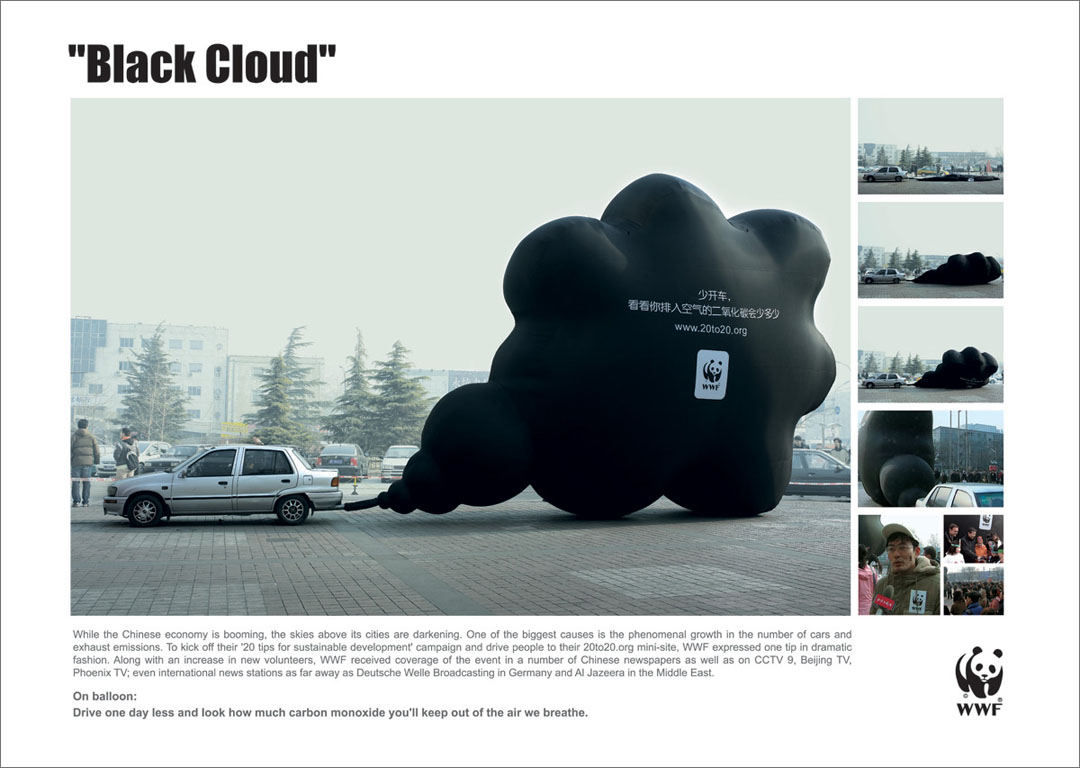
For The World Wildlife Fund:


For Medicine Without Borders (one of my FAVORITES):

For endabuse.org

For a Stop Smoking Campaign in South America:

For a Greenpeace Global Warming campaign (incudes various other cities):

For Mothers Against Drunk Driving:

For the World Wildlife Fund:

*For the World Wildlife Fund:

Award-winning solar-powered billboard for NedBank in South Africa:

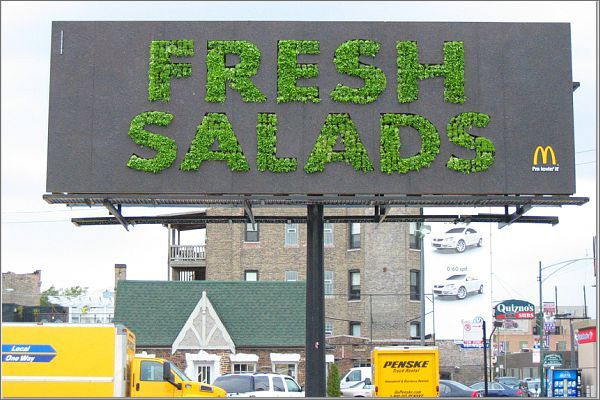
For the always-healthy McDonald's:

Cut-Outs for the Bronx Zoo:

For Amnesty International:

For Institute Akatu in Brazil:

For more information, check out adsoftheworld.com

Friday, November 30, 2007

Tom Tom, where can I take out a loan for gas?


While the government tried this a while back, it only made sense that an internet company could do it better. In addition to finding you the lowest gas prices, this new mapquest service has a built in a filter that tracks down stations with alternative fuels: biodiesel, E85, hydrogen, EV charging stations, CNG and more.

But don't be an idiot. Just because gas is 7 cents cheaper in Indiana doesn't mean it's more economical to go there. I can't count the number of time someone has gloated about getting a cheap tank, only to find out they drove 55 minutes out of their way to do so...in their Expedition...with low tire pressure...doing rabbit jumps at stop lights...while texting on their cell phone about finding low gas prices.

The site just started yesterday so it might take a few to catch on, but I have a sneaking suspicion this will be the end-all for gas price websites.

Thursday, November 29, 2007

If a press release about trees falls in the forest...

It's funny how you can tie a number to a news story and it sounds impressive. 1 billion trees planted in 2007? Hmmm...

Consider this: 1.6 billion trees are produced and shipped by forest tree nurseries annually. Forest product nurseries produce 852 million trees, private nurseries produce 366 million trees, state nurseries produce 348 million trees, and federal nurseries produce 38 million trees. Georgia's tree nurseries alone produce over 250 million trees each year and grow the most seedlings out of any other state. Nearly 79% of all tree production in the United States occurs in the South. Western nurseries produce 17% and Northern nurseries produce 4% of total U.S. tree production. [1]

1 billion trees planted in 2007? I don't think we should start the parade just yet.

It's also confusing when the UNEP website says that they're already up to 1.5 billion.

Is this supposed to be a lot? What's the plant-to-cut ratio? How long will these plantings take to mature? Will they be protected? Are they concentrated in areas that need them? Shouldn't this kind of thing be commonplace by now? Why are we celebrating something we should be doing anyway? Are 20 million trees in Myanmar celebratory in the face of massive Human Rights violations?

More than a billion trees planted in 2007: UN
28/11/2007

Kenyan farmers tend to newly planted trees ©AFP/File - Tony Karumba

NAIROBI (AFP) - More than one billion trees have been planted around the world in 2007, with Ethiopia and Mexico leading in the drive to combat climate change, a UN report said Wednesday.

The Nairobi-based UN Environment Programme (UNEP) said the mass tree planting, inspired by Nobel Peace laureate Wangari Maathai, will help mitigate effects of pollution and environmental deterioration.

"An initiative to catalyze the pledging and the planting of one billion trees has achieved and indeed surpassed its mark. It is a further sign of the breathtaking momentum witnessed this year on the challenge for this generation -- climate change," UNEP chief Achim Steiner said in a statement.

"Millions if not billions of people around this world want an end to pollution and environmental deterioration and have rolled up their sleeves and got their hands dirty to prove the point," he added.

UNEP said the total number of trees planted is still being collated, but developing countries top the list with more than 700 million and 217 million trees planted in Ethiopia and Mexico respectively.

Others include: Turkey 150 million, Kenya 100 million, Cuba, 96.5 million, Rwanda 50 million, South Korea 43 million, Tunisia 21 million, Morocco 20 million, Myanmar 20 million and Brazil 16 million.

Maathai's Green Belt Movement planted 4.7 million trees, double the number of trees it had initially pledged, according to UNEP.

Experts says that trees help contain carbon that accumulates the heat-trapping gases blamed for climate change.

Although the figure could not be verified, it sends a powerful message ahead of the December 3-14 meeting in Bali of the UN Framework Convention on Climate Change (UNFCCC), a panel charting the path for negotiating pollution cuts to be implemented after 2012 when the Kyoto Protocol pledges run out.

"We called you to action almost exactly a year ago and you responded beyond our dreams," said Maathai, who won the Nobel Peace prize for her campaign to plant tens of millions of trees to counter tree-loss and desertification in Africa.

"Now we must keep the pressure on and continue the good work for the planet," Naathai said in the statement.

Wednesday, November 28, 2007

I don't think we're in Detroit anymore, Toto...

Foster + Partners carbon neutral design "Motor City" won a competition back in April in Aragon Spain, but I just discovered it today and felt it was worth a mention. The shape and design, given the surrounding background, didn't exactly scream sustainability. But I digress...

The roof of the pavilion, designed with the slick curves of an F1 racer, is laden with photovoltaic cells, solar thermal tubes, and wind turbines. The resulting aerodynamics, in addition to the modified guts and gears, make the building carbon neutral.

Want to take a virtual tour?


I, however, only believe in the claim of carbon neutrality 10 years after construction...with biiiig stacks of reports/facts/evidence. Regardless, I was pretty amazed with the work F+P has done over the years. Pretty amazing stuff.

Then again, I'm not sure I would want to change the landscape of Aragon, Spain. Beautiful.

Anywhoo, from their website:

Foster + Partners has won the international competition to create La Ciudad del Motor -Motor City – a major new leisure and cultural zone within a new motor sports centre in Alcañiz, Aragon, it was announced today. The scheme was chosen from a shortlist of internationally-renowned architectural practices; Jean Nouvel, Dominique Perrault, UNStudio and MVRDV.

The design of Motor City is inspired by the sleek aerodynamic aesthetic of the racing car. The smooth forms and volumes of the building are sculpted by solar and wind patterns with a lightweight roof that floats over the entire complex. Motor City will use passive environmental controls as well as harnessing renewable energy, enabling the whole complex to be carbon neutral.

The roof integrates sustainable design elements such as photovoltaic cells and solar thermal tubes on its surface together with an array of wind turbines. The sweeping roof culminates in a tower which gives the development its identity. When illuminated at night, it will become a beacon for Motor City, echoing the nearby Parador of Alcañiz announcing a new era of sustainable development for the region.

The practice is opening a new office in central Madrid in May to look after and develop its work in Spain. This competition win is the latest in a group of projects the practice has recently won throughout Spain that includes Madrid’s City of Justice, the headquarters for Repsol YPF, a winery for Faustino and a masterplan for Seville.

Tuesday, November 27, 2007

Briefly briefing you on brief trends...

I've always been an annual fan of TrendWatching.com. Once a year, we'll get an email from a lead designer pointing us to this year's Trend Report.

It's one of those websites that you'll forget about, not bothering to place into regular-surfing-rotation (considering you're far too busy with the important sites), then out of nowhere it'll ping your inbox and remind you that you only have 28 days to to buy your wife an Aveda store (seriously though, thank God for cyber Monday...yesterday, for lunch, I ate a big fat slice of previously amortized credit card debt).

Yes, this annual read is chock full of fun. First and foremost, let me baptize you about the site:

trendwatching.com is an independent and opinionated trend firm, scanning the globe for the most promising consumer trends, insights and related hands-on business ideas. For the latest and greatest, we rely on our network of 8,000+ spotters in more than 70 countries worldwide.

Most of our findings are aggregated in a free, monthly
Trend Briefing, which is sent to 130,000+ business professionals in more than 120 countries. To read the latest edition of the Trend Briefing, please go to www.trendwatching.com/briefing/.

Basically, it's the bastard child of Best Week Ever, Consumer Reports, and the New Yorker New Yorker and Consumer Reports are in the midst of a very ugly paternity battle). It's funny, witty, very observant, almost borderline after-the-fact obvious.

I love trendwatching for coining the term trysumer. I've copied and pasted enough, so I won't even try to lift it from their site, so go here and check it out.

Too lazy? OK. Long story short: a trysumer is a daring consumer able to pick out new/exciting objects from a very saturated market of new and interesting stuff (seriously, go read their page...that was awful).

Trendwatching also calls us Generation Content. I love it.

But do you really need their lists? I'm not quite sure I would understand the report if I wasn't previously aware of current trends in the first place. Hmm. Tree falling in a forest?


This year's December briefing is just as good as ever, highlighting various issues (see: header picture) and touching on some should-be-obvious subjects. Renova black toilet paper even gets a mention, and we all know my feelings about that.

Once you're hooked on that, I suggest checking out all of their back-issues.

Here's an excerpt from this month's briefing:

..the rise of high net worth individuals (HNWIs) has an equally significant impact on consumerism. Consider the following numbers, from the 2007 World Wealth Report by Merrill Lynch and Capgemini:

-The number of HNWIs—individuals with net assets of at least USD 1 million, excluding their primary residence and consumables—in the world increased 8.3% to 9.5 million.
-The number of ultra-HNWIs—individuals with net assets of at least USD 30 million, excluding their primary residence and consumables—grew by 11.3% to 94,970.
-The BRIC nations (Brazil, Russia, India and China) continue to play increasingly important roles in the global economy. China and Russia were among the top ten countries with the fastest growing HNWI populations. China’s HNWI population grew by 7.8% to 345,000 people and Russia’s has increased by 15.5% to 119,000. Brazil (120,000 HNWIs) and India (100,000 HNWIs) also showed continued strength.

With so much (new) wealth and disposable income around the world, not only is there money to be made from selling premium goods, there’s also a constant need for redefining what constitutes luxury, for what constitutes status in bling-driven consumer societies. If millions have access to the same premium goods, to the same premium brands, these premium offerings lose some of their value...

-
Trendwatching.com

Monday, November 26, 2007

Curing sick buildings made for sick people...

I'm back but broken, so we're going to keep it pretty basic. I don't want to go and expose my immune system --or lack there of-- to all the viruses on teh interwebs (imagine Tommy Lee's .wmv file touching Tila Tequila's mySpace page...that's how germy I feel). So this is a simple, undemanding, clean post to bring me back.

Does your ICU need TLC?

With healthcare design beginning to crest at each and every green request, here's a wonderful report showcasing the various stages in which/on which/to which you can improve hospital performance. It seem pretty basic, but incorporates some case studies from UF, Emory, Kaiser Permanente and the Discovery Health Center, so it turns out to be an interesting read.

On a sidenote, isn't is funny how green tech no longer seems tech per se, but more "Hey, that's obvious"? I typed basic in the previous paragraph and paused for a moment.

I love looking back at the last two decades and seeing how far we've come. Now that the public is embracing sustainability, you'll read a report like the one featured below and wonder why they even need to point such obvious solutions, when only 15 years ago this report would have sounded like the operating instructions for an Excelsior NX-2000 Ship with experimental transwarp drive.

Likewise, I'm also amazed at how google can make you sound like a complete Star Trek junkie with one simple search, given the fact that my accumulated Star Trek watching amounts to paltry 2.34 seconds of my life.

It's the little things.

The report:

Building Healthy Hospitals:

The Pacific Southwest Regional Office of the U.S. Environmental Protection Agency (EPA) has worked with architects, designers, engineers, healthcare facilities and healthcare professionals to identify the "Top 5 Green Building Strategies for Healthcare" that support the Joint Commission’s Environment of Care objectives and best combine: enhanced community reputation; benefits to the environment, patients and staff; and cost competitiveness. The overview summarizes the benefits and case study results for each of the five green building strategies.

Top 5 Green Building Strategies for Healthcare:

-
Case Studies Overview (PDF)
-
#1:Energy Efficiency—Integrated Design and HVAC Systems (PDF)
-
#2:Process Water Efficiency (PDF)
-
#3:Sustainable Flooring Material Selection (PDF)
-
#4: Indoor Air Quality: Materials Selection (PDF)
-
#5:Lighting Efficiency—Optimizing Artificial and Natural Lighting (PDF)

Tuesday, November 20, 2007

Blah...

I'm out sick, so no posting.

I've narrowed it down to either a flu bug or the neighbor's Christmas lights. I'm sorry but in my book, even November is waaaaay too early. Regardless, something is making me vomitous.

Cheers.

Monday, November 19, 2007

It might be a green collar, but I still wouldn't pop it...


What do the following have in common?

-Bicycle repair and bike delivery services
-Car and truck mechanic jobs, production jobs, and gas-station jobs related to biodiesel
-Energy retrofits to increase energy efficiency and conservation
-Green building
-Green waste composting on a large scale
-Hauling and reuse of construction materials and debris (C&D)
-Hazardous materials clean-up
-Landscaping
-Manufacturing jobs related to large scale production of appropriate technologies (i.e. solar panels, bike cargo systems, green waste bins, etc.)
-Materials reuse
-Non-toxic household cleaning in residential and commercial buildings
-Parks and open space expansion and maintenance
-Printing with non-toxic inks and dyes
-Public transit jobs related to driving, maintenance, and repair
-Recycling and reuse
-Small businesses producing products from recycled materials
-Solar installation
-Tree cutting and pruning
-Peri-urban and urban agriculture
-Water retrofits to increase water efficiency and conservation
-Whole home performance, including attic insulation, weatherization, etc.

They're new money!

The aforementioned jobs are just a small slice in a VAST growing section of green collar enterprise. The sustainable movement is attracting a whole new breed of worker, with various estimates reporting that green collar jobs could top 40M by 2030. CEO and founder, Mother Nature, was unavailable for comment.

And apparently --contrary to popular belief-- white and blue make green. This third sector is evolving into a growing market of labor AND tech, exhibiting DNA traits of both. Not to say that the job of your run-o-the-mill plumber is strictly blue collar. Lord knows I would flood my house in seconds flat if I were faced with a leaky garbage disposal. Additionally, traditional plumbing parts and fixtures are becoming more and more complex. So please don't think that I mean that with any disrespect. But the tech and labor green collar combo is so important because the market has never trended faster. General construction is now awash in a sea of green, so much so that even architects are running out ways to categorize information. Who will act as interpreter?

Washington DC is on the right track. Not only do they understand the need for growth, but they're keeping it local.

Their apprentice programs are training workers > Trained workers beautify the city > Pretty cities spur investment > Investment brings more work to trained workers.

There's the inner-city.
There's the unions.
There's Oakland.
There's the Bronx.

New Orleans, I'm looking at you.

From the DC website:

The community and economic benefits of Green Collar Job Training and job placement are many. Our apprenticeship programs:

-Provide employment opportunities to under-served urban populations;

-Build clean and green communities and prioritize the need for green collar jobs in urban centers;

-Teach fundamental, marketable skills in an interactive, hands-on, inquiry-based manner that makes learning easy and fun;

-Nurture confidence, social skills, and a healthy respect for environmental stewardship;

-Support businesses in improving products and services through customized horticultural enhancements and cost-saving techniques;

-Assist green job placement through partnerships with local businesses, regional green employers, and employment services agencies;

-Form viable partnerships with job-readiness, job placement, AmeriCorps, Youth Opportunity, Project Empowerment, and other workforce development programs;

-and Supply needed services and beautification to local sites utilized in our training courses.