I haven't seen much on the blogfront in terms of HVAC and refrigeration since the Freeaire craze of last year (now installed in Killington, VT, where they estimate they're now saving more than 86,389 kilowatt hours of electricity, while eliminating an estimated 58 tons of global-warming CO2 emissions annually!!!), so I thought I might see what's on the horizon...
My search brought me to Ice Energy's Ice Bear, an amazingly simple concept with an equally simple installation procedure (off-the-shelf easy).
Similar to Freeaire, the Ice Bear utilizes cool air conditions to reduce power consumption. Whereas the Freeaire system requires frigid conditions to operate at maximum efficiency, the Ice Bear condenses and freezes water at night when energy consumption is less costly. It then holds the frozen water in an insulated storage tank until daytime when the weather warms.
As the warmer daytime temperatures engage the air conditioning, the refrigerant is forced through the coils in the stored ice and chilled before being pushed in to the building's HVAC ducts, thus providing a cool stream of efficiently refrigerated air.
The Ice Bear® 50 system has a capacity of 50 Ton hours of cooling, including 45 latent + sensible and an additional 5 sensible only. The unit provides 7.5 Tons of cooling capacity for 6 hours of continuous cooling.
Typical configurations:
-7.5 Ton for 6 hours -5 Ton for 8 hours or more -Offloading of 10 Ton rooftop unit, where 10 Ton unit is oversized due to high rooftop temperatures -Offloading one stage of a 10, 15, or 20 Ton, 2-stage rooftop unit
There is also a residential unit capable of eliminating up to 95% of on-peak air conditioning demand. And as an added bonus:
Assists LEED certification
-Adds 3 or more points to the Energy and Atmosphere credits
-Contributes to Indoor Air Quality (IAQ) credits
-Brings Thermal Energy Storage (TES) enabling performance to refrigerant based air-conditioning projects
Now, since the Ice Bear claims to use an equal or lesser amount of energy --in addition to delivering a consistent capacity on 95+ degree days with no degradation in performance and no increase in power consumption-- I'm interested to see if this concept could be hacked to eliminate the majority of the power usage all together.
Consider a location like Kuwait that has an average January low of 45 degrees Fahrenheit and an average August high of 112 (the low for that month is a crisp 83 degrees)! With the exception of brown-outs caused by dust storms throughout June and July, I think it's safe to say that the area is drenched in sun.
So why not saturate the rooftop in solar, submerge the unit's storage containers underground to twice-insulate their exteriors from the harsh conditions,* and store the daytime energy in batteries for nightfall, using the saved energy to refreeze the cores at night?
*You're only depth-limited by accessibility...sink the parking 5-10 floors below the building and you could run the unit subterraneaously, making it even more efficient, but still accessible for repairs.Check some of the commercial case studies and decide for yourself. I think there are benefits that exceed the burden of peak consumption. I just don't have the book learnin' to prove it.
At the Zenith of Solar Energy Israeli energy startup Zenith Solar is pioneering a "concentrated solar power" method that is up to five times more efficient than standard technology
by Neal Sandler Busines Week: Energy & Environment March 26, 2008, 1:20PM EST
Rooftops all over Israel look strikingly similar: More than 1 million households in the nation of 7.1 million people have solar panels that produce hot water—a relatively simple technology that gained popularity after the 1973 Arab-Israeli war, when oil prices shot up sharply. As of the early 1990s, all new residential buildings were required by the government to install solar water-heating systems.
Yet despite Israel's sunny climate and early lead in solar heating, it has been slow in adopting more sophisticated solar technologies that produce electricity from sunlight. Now, with oil hovering near $100 a barrel, a local startup hopes to build on the country's early embrace of sun power to carve out a new clean-energy business.
Zenith Solar, based in Nes Ziona near Tel Aviv, is a pioneer in a new type of solar energy that uses mirrors and lenses to focus and intensify the sun's light, producing far more electricity at lower cost. Compared with traditional flat photovoltaic panels made of silicon, this so-called "concentrated solar power" technology has proved in tests to be up to five times more efficient. That puts it on the verge of being competitive with oil and natural gas, even without government subsidies.
A Boost to Israel's Energy Supply "Our goal is to utilize every suitable roof, backyard, and open space in Israel to turn households, hotels, and factories into net producers of electricity and thermal heat," says Roy Segev, the founder and chief executive of Zenith Solar. Founded in 2006, the startup has raised $5 million from a handful of private investors in Israel and the U.S. Now it's trying to raise an additional $10 million to $15 million to cover the cost of commercializing its technology.
The opportunity is compelling. Israel's National Infrastructure Ministry estimates solar panels for water-heating already satisfy 4% of the country's total energy demand. With technology like Zenith Solar's widely installed, the figure could jump to more than 16%—a big boost for a country now almost totally dependent on imported energy.
Zenith bought the rights to the solar technology from Ben-Gurion University and Germany's Fraunhofer Institute. A joint Israeli-German research team from the two organizations designed a working prototype, which consists of a 10-sq.-meter (107.6-sq.-ft.) dish lined with curved mirrors made from composite materials. The mirrors focus the sun's radiation onto a 100-sq.-centimeter (15.5-sq.-in.) "generator" that converts light to electricity. The generator also gives off intense heat, which is captured via a water-cooling system for residential or industry hot-water uses.
Tested over the past few years at Israel's National Solar Center in the Negev desert, the prototype achieved astounding results: A concentration of solar energy that was more than 1,000 times greater than standard flat panels.
Avoiding Costly Panels One of the biggest advantages of Zenith Solar's approach, especially in today's market, is its limited use of polysilicon. Skyrocketing global demand for traditional photovoltaic panels has led to a worldwide shortage of the material and lifted prices tenfold in the past four years. "Photovoltaic material accounts for 80% of the cost of standard systems," says David Faiman, chief scientific officer at Zenith, and a 30-year solar-energy veteran who was part of the development team. "Our technology succeeds in reducing this to less than 10%, while at the same time obtaining very high efficiency."
After further refining the technology, Zenith plans in the coming months to take its first major steps toward commercialization. Two large-scale test installations are planned for this summer at a kibbutz and a factory. The company will put 86 of its 7-meter-high dishes on an acre of land at Kibbutz Yavne to provide the community of 250 families with more than a quarter of their energy needs. The second project will replace fuel oil used to produce heat at a large chemical plant in central Israel.
Read the rest of the Business Week article HERE. Read an older article from Reuters HERE. Read a Next Energy News article HERE.
It's conveniently disguised to look like a portable radio, but transitions into a gun faster than you can turn off a Jessica Simpson song. Coincidentally, both of the aforementioned items produce equal amounts of pain.
Why anyone would ever need a gun disguised as a radio seems rather mischievous to me (to put it lightly) and I'm not quite sure what kind of good could ever come of it...
...additionally, I'm not quite sure if I understand. If you go to the trouble of beach camouflage, why not add a modern iPod scroller or make it Sirius/XM capable? The AM weather radio look is sooooooo 60's. Or why not go completely retro and pimp it out in a ghettoblaster body/50 caliber fold-out mod? Breakin' III: Electric Semi-Automatic Laser Scope Boogaloo.
2. The Nokia shape changing nano-phone, Morph, isn't exactly a transformer...but it is more than meets the eye.
This shapeshifter utilizes space-age nanotechnology to give it elasticity, literally breaking the mold of it's plastic brethren.
The concept demonstrates how future mobile devices might be stretchable and flexible, allowing the user to transform the gadget into radically different shapes.
The more drop-friendly electronics become, the less replacements my clumsy self will need to buy. Excellent. And while the concept is uber cool, I can honestly say that I won't be spending a dime until it copies newsprint with the press of a thumb.
Winner of two 2007 Nano50 awards, this novel approach to solar harvesting is garnering a lot of interest. Not only does it have the capability to replace existing solar technology, but but it could potentially cost pennies a yard.
Idahp National Laboratory researcher Steven Novack holds a plastic sheet of nanoantenna arrays, created by embossing the antenna structure and depositing a conductive metal in the pattern. Each square contains roughly 260 million antennas. Nanotechnology R&D usually occurs on the centimeter scale, but this INL-patented manufacturing process demonstrates nano-scale features can be produced on a larger scale.
There's a slight snag in the sweater, though. They're still trying to create a way to store or transmit the electricity. The alternating frequency of the current switches at a speed 10 thousand billion times a second (seriously) and that's waaaay too fast for your average blender or refrigerator to handle.
4. The Urban Skiff...it's not a schooner, it's a sailboat you idiot!
Earlier this month, Yanko Design featured an amazing invention by Thomas Giger, Anita Meyer, Florian Ueker, Femke Morf and Thomas Etter.
What looks to be a normal everyday skiff is, in fact, a collapsible version of its floating friends. Initially, I thought the urban in its name applied to its proposed usage; on small ponds in big cities, where owners would have little room to store their boats when not in use. The comment section, however, provide an interesting observation/application. User Funkenstein states:
I want one of these. Living in NY, if the sh*t were to hit the fan, everybody would be flooding the bridges, tunnels and roads out of the city. If you had one of these, you could sail down the river laughing at all the land lubbers getting eaten by zombies. In fact, they should make that the name of the product: “Escape the Zombie Apocalypse Boat”
So I'm not quite sure if this should be filed under foldable boat or foldable escape hatch, but I never would have thunk it to be used for emergency purposes, regardless of its obviousness. Still awaiting a pricepoint, though. If an apocalyptic emergency response firm gets their hands on the skiff, expect the cost to increase 500%.
OK, I know, I know...how many decades of foldable bicycles does it take before designers just give up already? There are numerous hurdles to jump and it seems as though every designer has, historically, come up short. Their offerings have been either awkward, inefficient, bulky, flimsy, or just plain ugly. Well, the crossbreed plans on changing all that:
The crossbreed folding wheel enables a full sized adult bicycle or wheelchair to be folded into a compact and convenient package for transportation and storage.
The project is currently being developed further in association with InnovationRCA, an innovation incubator affiliated with the Royal college of Art, London.
Just when you thought it couldn't get more ridiculous, the fashonistas had to jump in! Yet another Yanko submission, the foldable shoe is attempting to turn the manufacturing sector around by speeding up production and nearly eliminating the cost of shipping all together. A flat-pack shoe would dramatically reduce transportation cost, given the fact that each shoe box is void of so much usable space.
Is it practical? Well, see for yourself.
It is, however, interesting. And aesthetically, it's more than I expected. And if they continue to charge $50 per extra bag on flights, expect a flat-pack travel shoe to start selling well.
Seen at the 2007 Tokyo auto show, Bobby is Yamaha's answer to the commute. It doesn't collapse as much as I would like, but when sticking a scooter in your trunk, every inch can count. As you can see, the handle bars fold down and the back wheel folds inward. Soooooo, err, what makes it different? Well, this RFID enabled scooter can be turned on and off with a FeliCa-enabled cellphone. Feel free to ooh and ahh at will.
And if the rumors that suggest the Bobby has internet access are true, feel free to file this under idiotic. You'll be the only commuter to ever get laughed at by somebody on a Segway. Otherwise, keep the prototypes coming. Somebody's bound to hit the nail on the head sooner or later.
Marketers have found that there's a decrease in home television audiences, so they're looking for newer ways to shove adverts down our gullets. Yay.
I couldn't figure out why the video quality was so bad (all over the web, not just here), but it's because the shirt is basically an LCD screen stuck in a t-shirt, not a flexible screen capable of be washed.
Boats, in the foldable community, seem to be quite commonplace, but these Feathercraft Kayaks really stand out.
Ingenious design features have been incorporated to each model. The framework assembly of each model has similar characteristics, yet each is uniquely different. Longitudanal sections are shock-corded together like tent poles. To minimize assembly steps, chine and gunwale tubes for both the bow and stern frame sections are permanently attached to keel reinforcements plates. Deck bars are used as lever bars to extend the frame sections tightly into the skin. No additional tools are required for assembly. Because the framework is sectional, should damage occur, the individual section can easily be repaired or replaced. Crosspieces are either hand-cut from high density polyethylene, or are injected molded polycarbonate, depending on the model.
OK, so I didn't understand any of that...
But when I said that they stand out, it was actually because of the photo gallery. A pack-and-kayak retirement would be pretty friggin' awesome. There's numerous shots of people floating the waters of Venice, under and in between crevasses, along coastlines, etc.
The SPLAT from Jill Davis Design is beautiful in form and function. It takes real talent to take something so commonplace and make it look interesting. And as one of the dishawasherless few, I can wholeheartedly appreciate this design.
Not to mention, the more you can hide something so typically bulky, the better. Although if my drying rack looked like this, I probably wouldn't put it away.
I have been a HUGE fan of classic camper design for quite some time now (and yet somehow, I managed to land a wife). You've heard me go on and on about my love for the classic American standard, the Airstream. What can I say? Nothing gets my wheels turning like a 36' silver twinkie.
And even though I've yet to do a full-length post about my toy-lust for its brother --the shapely tear drop camper-- I can assure you my toy-lust for this towable is one in the same. For instance, check out this beauty:
How could you resist those lines? I definitely wouldn't kick it out of my camp site...classic whitewalls, beautiful curves, simplicity...ahhh, to dream.
Well, yet another camping icon has done the impossible and improved upon an already brilliant design.
For decades, Deadheads and hippie CEO's have commuted to/from the granola farm in Volkswagen style, whirring and squeaking their loaf-like Westfalias at (almost) the speed of sound (by speed of sound I mean speed limit). Held together by bumper stickers and resin, the v-dub design has lasted the test of time, thus leading to some truly awesome customizations and fabrications.
Like this retro stretch mod with camper top:
Or this crunched version:
Or this stretch mod with pristine paint:
I swear, those fold-out windows make me giddy every time.
Well, Canadian designer Alexandre Verdier is my new best friend. He's taken the iconic hippie-mobile, added a dash of hippie, sprinkled some hippie, and garnished it with hippie dippie.
BEHOLD:
The Verdier Westfalia! It has just about everything. And the everything has just about everything. For instance, this solar/diesel hybrid doesn't employ simple solar tech, but instead uses modern solar-tracking technology that follow the sun's path for maximum exposure. The cooking range swivels so you can get your soy dog on both inside AND outside of the van.
There's also other light touches: a multi-media computer with wireless internet, a maple exterior veneer, a pneumatic suspension for stationary stability (when lowered), an energy consumption dashboard, a passenger seat that turns into a staircase (seriously), and a half door that also turns into stairs:
For his work, Verdier and his team received the Special Prize at the Caravaning Design Award 2006/2007 at the Caravan Salon in Dusseldorf, Germany. The Salon is one of Europe's largest caravan exhibition and trade shows.
UPDATE: My boss sent me this. I can't say I'm a fan (of the slick new appearance, not my boss). How could you throw away all of that classic character? I'd rather they remake the new Westfalia identical to the old Westfalia.
The above solar furnace was opened, appropriately, at the dawn of the disco era in the Pyrenees of France, and remains the largest solar furnace in the world. Basically, the curved face of the structure is covered with mirrors and acts as a parabolic reflector, concentrating and isolating the reflected light into a centralized location the size of a basketball hoop. The reflection is so powerful that it can reach a temperature of up to 5,432 degrees Fahrenheit.
Why France? This particular location is competing with Southern California, seeing as it's sunny 300 days out of the year. Why build one at all? This particular application is expected to advance much of anything on this planet. However, the structure might prove useful outside of our atmosphere on space missions. It is so powerful that it could produce heat, power and aid in the production metals and other materials for industry.
The concept itself dates back Archimedes when, in 200 BC, a parabolic reflector was said to by built and used as a weapon of war. Some of you might remember Adam and Jamie's mythbusting attempt, replicating the experience. Although Adam and Jamie could not initially find plausibility in the legend, a group of supernerds from MIT recreated --with success-- the boat-destroying build in 2005.
Although the solar furnace concept appears to be orbit-bound, new(er) advancements in solar technology have produced some amazing results. Relying on the same principles, the 'Heliostat' power plant (pictured below) utilizes mobile mirrors to continuously reflect the sun to a central point in the tower. Instead of re-reflecting the light to another point, the structure actually absorbs the heat internally for later use. In most instances that heat is used to boil water, thus powering internal or external steam turbines.
Near Seville, Spain:
'Solar One' in Boulder City, Nevada:
Decommissioned 'Solar Two' in Daggett, California:
Where are solar towers going to take us? Well, the January 2008 issue of Scientific American believes that we're on the verge of "A Solar Grand Slam," able to end the U.S. dependence on foreign oil and carbon emissions by 2050. Granted the whole article doesn't focus solely on solar tower technology, but who said that one individual tech-sector was going to save the world?
Key points from the article:
A massive switch from coal, oil, natural gas and nuclear power plants to solar power plants could supply 69 percent of the U.S.’s electricity and 35 percent of its total energy by 2050.
A vast area of photovoltaic cells would have to be erected in the Southwest. Excess daytime energy would be stored as compressed air in underground caverns to be tapped during nighttime hours.
Large solar concentrator power plants would be built as well.
A new direct-current power transmission backbone would deliver solar electricity across the country.
$420 billion in subsidies from 2011 to 2050 would be required to fund the infrastructure and make it cost-competitive.
That piece is all well and good, but articles like this don't geek me up half as much as artistic renditions like these (see below). It's a proposed parking structure covered with a solar tower field.
Drool.
Final note, all investors should keep a sharp eye on Sunpower Corp. Picture Exxon with a free oil tap.
Just watch. California/Nevada/Arizona will (sooner than you think) take over as the new Middle East.
We better stop, hey, what's that sound Everybody look what's going down...
Berkeley has always been beating to a different bongo drummer.
It's only fitting that the University responsible for the Manhattan project also function as the original command post for the Free Speech Movement - trading bomb for calm. You can see it everywhere. In People's Park, on the infamous Bloody Thursday of 1969, James Rector died at the hands of a police shotgun. Now, the former site of the anti-war protest is a nerve center for a satellite Food Not Bombs program - a fitting end to its tragic beginning.
The school has always been at the forefront of the progressive movement. And while there are still some programs that might seems a little sketchy, possibly calling in to question their current "independence of direction" --$500 Million donation from BP to develop biofuels, $10 Million donation from DOW for sustainability-- the city/University area of Berkeley is, yet again, still way ahead of the curve.
And I'm jealous...
Berkeley's City Council has a wonderful plan for the city to finance solar panels for its residents. Basically, the homeowners pay for their panels through a 20-year additional assessment on their homes, with said assessment GUARANTEED not to exceed what their electricity would cost from the power company.
Berkeley is set to become the first city in the nation to help thousands of its residents generate solar power without having to put money up front - attempting to surmount one of the biggest hurdles for people who don't have enough cash to go green.
The City Council will vote Nov. 6 on a plan for the city to finance the cost of solar panels for property owners who agree to pay it back with a 20-year assessment on their property. Over two decades, the taxes would be the same or less than what property owners would save on their electric bills, officials say.
"This plan could be our most important contribution to fighting global warming," Mayor Tom Bates said Thursday. "We've already seen interest from all over the U.S. People really think this plan can go."
The idea is sparking interest from city and state leaders who are mindful of California's goals to reduce greenhouse gas emissions by 25 percent by 2020. Officials in San Francisco, Santa Cruz, Santa Monica and several state agencies have contacted Berkeley about the details of its plan.
"If this works, we'd want to look at this for other cities statewide," said Ken Alex, California deputy attorney general. "We think it's a very creative way to eliminate the barriers to getting solar panels, and it's fantastic that Berkeley's going ahead with this."
As consumers become more and more numb to typically-blah advertising --even in contextually appropriate settings-- businesses are forced to speed up their hamster wheels in order to grab our attention. With varied statistics it's hard to tell how ad-saturated we really are, but this might give you an idea of what these ad execs are competing against:
Research tells us that the average American consumer is exposed tomore that 600 advertising messages a day in one form or another. -The Business Journal Phoenix
The average American is exposed to about 3000 advertising messages a day, and globally corporations spend over $620 billion each year to make their products seem desirable and to get us to buy them. -Michael Brower, PhD, and Warren Leon, PhD, Union of Concerned Scientists
As a result, socially conscience and devilishly interactive advertising has been begun to break the marketing atmosphere, shattering the mold in order to evoke a consumer emotion far deeper than the buy me.
While more and more attention is being garnered by these organizations, big corporations are beginning to take notice. Check out these innovative advertisements by non-profits, governments, and social organizations, with a few green-washed billboards thrown in (see: McDonald's).
Click for bigger.
Cancer Patient Aid Association ceiling poster campaign:
For Amnesty International:
For The Salvation Army:
For Denver Water's "Use Only What You Need" Campaign:
For The Red Cross (with various other locations):
For the Focus 12 Rehab Center:
For a deforestation campaign (similar to WWF campaign pic below*)
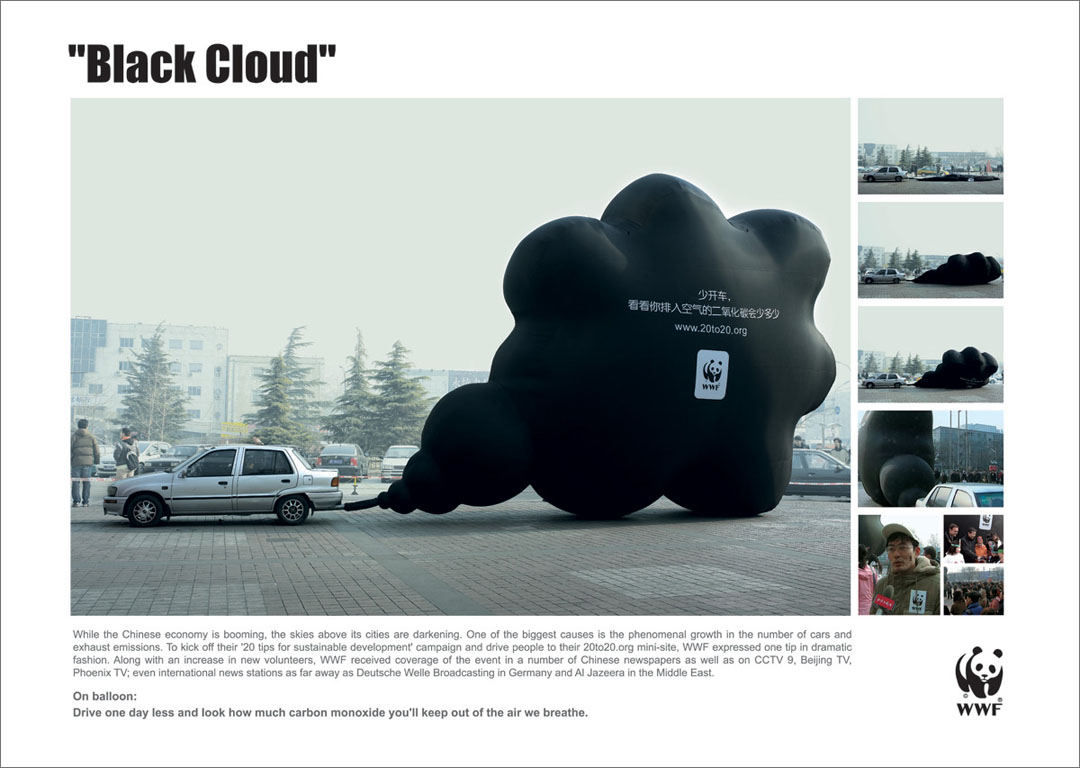
For The World Wildlife Fund:
For Medicine Without Borders (one of my FAVORITES):
This site is not affiliated with my work and/or its clients and/or its vendors. The views expressed in this blog are solely the opinions of me, myself and I.
1) Everything is meant in good fun. 2) At this time, there is just too much cool stuff on the interwebs and this is my way of keeping track of it all. 3) My intent is to better familiarize myself with an industry I am only beginning to understand.
Well, where to begin? I graduated from Eckerd College in 2000 [St. Petersburg, FL] with a BA in International Law with a Concentration in Human Rights and Genocide Studies. After college I joined the Peace Corps, serving in the Republic of Kiribati in the South Pacific [2001-2003]. I am currently a Buyer for a design in OH.********As the world continues to accelerate and evolve, I am growing more and more fascinated with technology and design. Since I am not formally trained in either of those fields, this blog aims to showcase products/ideas/tech/people I like. Take it for what you will.********Lili Cheng once wrote, "A beautiful side effect of making things is you start to look around and wonder, 'how did they do that?'; you learn to see, analyze, and appreciate different approaches, well-made things, and clever solutions." Surrounded by creativity and cleverness, I can't help but find myself intrigued.
I have a wonderful wife and a healthy-boweled 1 year-old son.

 My search brought me to Ice Energy's Ice Bear, an amazingly simple concept with an equally simple installation procedure (off-the-shelf easy).
 Similar to Freeaire, the Ice Bear utilizes cool air conditions to reduce power consumption. Whereas the Freeaire system requires frigid conditions to operate at maximum efficiency, the Ice Bear condenses and freezes water at night when energy consumption is less costly. It then holds the frozen water in an insulated storage tank until daytime when the weather warms.
 As the warmer daytime temperatures engage the air conditioning, the refrigerant is forced through the coils in the stored ice and chilled before being pushed in to the building's HVAC ducts, thus providing a cool stream of efficiently refrigerated air.

 There is also a residential unit capable of eliminating up to 95% of on-peak air conditioning demand. And as an added bonus:
 Check some of the commercial case studies and decide for yourself. I think there are benefits that exceed the burden of peak consumption. I just don't have the book learnin' to prove it.


 ...additionally, I'm not quite sure if I understand. If you go to the trouble of beach camouflage, why not add a modern iPod scroller or make it Sirius/XM capable? The AM weather radio look is sooooooo 60's. Or why not go completely retro and pimp it out in a ghettoblaster body/50 caliber fold-out mod? Breakin' III: Electric Semi-Automatic Laser Scope Boogaloo.


 It is, however, interesting. And aesthetically, it's more than I expected. And if they continue to charge $50 per extra bag on flights, expect a flat-pack travel shoe to start selling well.
 Then give me a reason where and why I would ever need to wear a shirt with a screen on it.
 Ingenious design features have been incorporated to each model. The framework assembly of each model has similar characteristics, yet each is uniquely different. Longitudanal sections are shock-corded together like tent poles. To minimize assembly steps, chine and gunwale tubes for both the bow and stern frame sections are permanently attached to keel reinforcements plates. Deck bars are used as lever bars to extend the frame sections tightly into the skin. No additional tools are required for assembly. Because the framework is sectional, should damage occur, the individual section can easily be repaired or replaced. Crosspieces are either hand-cut from high density polyethylene, or are injected molded polycarbonate, depending on the model.
 How could you resist those lines? I definitely wouldn't kick it out of my camp site...classic whitewalls, beautiful curves, simplicity...ahhh, to dream.
 Or this crunched version:
 Or this stretch mod with pristine paint:
 I swear, those fold-out windows make me giddy every time.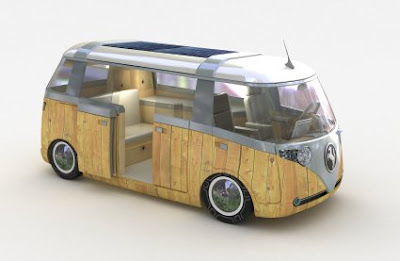
 It has just about everything. And the everything has just about everything. For instance, this solar/diesel hybrid doesn't employ simple solar tech, but instead uses modern solar-tracking technology that follow the sun's path for maximum exposure. The cooking range swivels so you can get your soy dog on both inside AND outside of the van.
 There's also other light touches: a multi-media computer with wireless internet, a maple exterior veneer, a pneumatic suspension for stationary stability (when lowered), an energy consumption dashboard, a passenger seat that turns into a staircase (seriously), and a half door that also turns into stairs:
 For his work, Verdier and his team received the Special Prize at the Caravaning Design Award 2006/2007 at the Caravan Salon in Dusseldorf, Germany. The Salon is one of Europe's largest caravan exhibition and trade shows.


 'Solar One' in Boulder City, Nevada:
 Decommissioned 'Solar Two' in Daggett, California:
 Where are solar towers going to take us? Well, the January 2008 issue of Scientific American believes that we're on the verge of "

 The school has always been at the forefront of the progressive movement. And while there are still some programs that might seems a little sketchy, possibly calling in to question their current "independence of direction" --$500 Million donation from BP to develop biofuels, $10 Million donation from DOW for sustainability-- the city/University area of Berkeley is, yet again, still way ahead of the curve.
 For Amnesty International:
 For The Salvation Army:
 For The Red Cross (with various other locations):
 For the Focus 12 Rehab Center:
 For a deforestation campaign (similar to WWF campaign pic below*)
 For The World Wildlife Fund: