Showing posts with label Bus. Show all posts

Thursday, March 26, 2009

From Maruja Fuentes.

I don't know about the elbow rest portion, but the sitting spot has excellent potential for bus stops, DMV's and the like. That is to say, potential for very hip versions of those places.

Wednesday, January 23, 2008

I need a tarp for my drool...

I have been a HUGE fan of classic camper design for quite some time now (and yet somehow, I managed to land a wife). You've heard me go on and on about my love for the classic American standard, the Airstream. What can I say? Nothing gets my wheels turning like a 36' silver twinkie.

And even though I've yet to do a full-length post about my toy-lust for its brother --the shapely tear drop camper-- I can assure you my toy-lust for this towable is one in the same. For instance, check out this beauty:

How could you resist those lines? I definitely wouldn't kick it out of my camp site...classic whitewalls, beautiful curves, simplicity...ahhh, to dream.

Well, yet another camping icon has done the impossible and improved upon an already brilliant design.

For decades, Deadheads and hippie CEO's have commuted to/from the granola farm in Volkswagen style, whirring and squeaking their loaf-like Westfalias at (almost) the speed of sound (by speed of sound I mean speed limit). Held together by bumper stickers and resin, the v-dub design has lasted the test of time, thus leading to some truly awesome customizations and fabrications.

Like this retro stretch mod with camper top:

Or this crunched version:

Or this stretch mod with pristine paint:

I swear, those fold-out windows make me giddy every time.
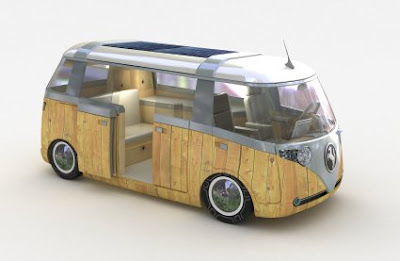
Well, Canadian designer Alexandre Verdier is my new best friend. He's taken the iconic hippie-mobile, added a dash of hippie, sprinkled some hippie, and garnished it with hippie dippie.

BEHOLD:

The Verdier Westfalia! It has just about everything. And the everything has just about everything. For instance, this solar/diesel hybrid doesn't employ simple solar tech, but instead uses modern solar-tracking technology that follow the sun's path for maximum exposure. The cooking range swivels so you can get your soy dog on both inside AND outside of the van.

There's also other light touches: a multi-media computer with wireless internet, a maple exterior veneer, a pneumatic suspension for stationary stability (when lowered), an energy consumption dashboard, a passenger seat that turns into a staircase (seriously), and a half door that also turns into stairs:

For his work, Verdier and his team received the Special Prize at the Caravaning Design Award 2006/2007 at the Caravan Salon in Dusseldorf, Germany. The Salon is one of Europe's largest caravan exhibition and trade shows.


Visit his website HERE.

Oh...and another thing...can I borrow $69,000?

UPDATE: My boss sent me this. I can't say I'm a fan (of the slick new appearance, not my boss). How could you throw away all of that classic character? I'd rather they remake the new Westfalia identical to the old Westfalia.

Thursday, November 8, 2007

Their taxis have masseuses...

What's the coolest (sorry) thing about the Wild Wadi Water Park in Dubai? As you can see from the picture below, it's definitely not the design. So what is it? The 33 metre high Jumeirah Sceirah water ride? Their Flowrider surfable wave? The Master Blaster uphill water roller coaster?

Nope. It's the air conditioned bus stop outside.

With more than 500 of them planned for the architecture-crazy city, everyone is crying environmental foul. Poppycock.

Numero Uno: Summer averages dance in triple digits, with the August record pushing 120 degrees! I think that would justify a need for air conditioning.

Numero Dos: They're installing these to help the environment.

What?

Yep. Help the environment. Think about it. How many bus takers are going to wake up, put on their kandura, and wait for 30 minutes in 112 degree weather? Not to mention, traffic jams are already commonplace in Dubai. Just last year, the situation was so bad that they started using satellites to monitor the city streets. And while a new interchange for the Dubai Marina and Emirates Hills is alleviating a portion of the problem, the city continues to expand at more-than-rapid pace.

The Jumeriah Beach Residence has more than 6,000 residential units and the Jumeirah Lake Towers are on the other side of Sheikh Zayed Road. The Palm Jumeriah has 3,000 villas. There's 50+ story residences like the 21st Century Tower. You've got the Jumeirah Emirates Towers Hotel. There's tourism at the Burj and plenty of other people staying at one of the many 1,000 unit 5-star hotels. Hoardes of people working and living in 60+ story buildings, like the Rose Tower, Al Yaquob Tower, and the HHH Tower.

That's a lot of people in one place.

The Salik road tolls are in place and, as mentioned, the interchange is alleviating some problems. But the Dubai Metro ($3.89 Billion!), the abras, and the city streets are only going to be able to handle so much. The more people on the bus, the better.

Friday, November 2, 2007

Quick update...

I nearly forgot. In keeping with the previous post...

For an all-too-real description of what it's like to ride public transportation, check out Mathew Baldwin of Defective Yeti fame. I laughed tremendously at his posts long before I took my maiden voyage on a public bus, then I shot gallons of funny out of my nose while taking the bus, thinking about the posts he had written. It's kind of like parenting: you can never fully understand it till you've been pooped on.

I've cued up all of his bus entries here.

Send provisions, I'm taking the bus...

According to the American Public Transportation Association:

"78 million more trips taken than last year in the first six months -- New report finds 30% of transit riders are new riders; majority of riders use transit to commute."As a new public transport commuter,* I am pleased by these findings...but dismayed by our Central Ohio public transport.

Just yesterday, I waited for my bus that was scheduled to arrive 5:43. I allotted myself +/- 5 minutes and showed up early. My bus was running late and didn't show up until 6:05. As a result, I missed my connection downtown and waited an additional 20 minutes for the next bus to come. I arrived at home at 7:05.

That's 87 minutes...with only one transfer...to go 12 miles.

Given the fact that the average cyclist can sustain 13 miles an hour, I recall looking enviously from my rattling window as the two-wheelers passed us by, envious of their ability to run red lights and move their legs freely, unburdened by the 425 pound man not sitting next to them.

But alas, I must admit, my gripes are few and far between. Let me emphasize that COTA is not a bad bus system (though it's name is not as cool as Seattle's South Lake Union Trolley, or S.L.U.T.). The buses are generally clean and the drivers are courteous. Once you figure out the routes, it's not that difficult to get around. And they even provide a healthy vein to bring OSU fans to and from the packed-to-the-gills games at the Horseshoe.

From their website:

For the 12 months ending December 2006, COTA provided nearly 15.0 million trips: 14.8 million rides on the fixed-route system and 156,000 paratransit rides. Compared to the prior 12-month period, fixed-route ridership decreased 1 percent and paratransit ridership increased 1 percent.

But if I was working a minimum wage job somewhere in the city, without any flexibility in a work schedule, 45 minutes of "tardiness" can cost me my livelihood. Not to mention 87 minutes is a healthy 12 miles. And the website...don't get me started on the website. Their Trip Planner is a friggin nightmare, where you need to know the exact case-sensitive punctuation they inputted in order to find out the stop's times. Just a simple pull down menu would work wonders.

And as far as public transportation goes, I recognize that this ebbing and flowing might be par for the course. Their will always be hiccups, but it is important to note that smaller scale bus systems like Columbus need a desperate overhaul. We're 1/20th the size of New York, yet we're based on big city planning without any customization to scale and need. Without street cars, dependable cabs (it's illegal to hail a cab in Columbus!) or a subway system, the lucky carless few are invariably stuck inside the 270 outerbelt.

From Wikipedia:

COTA has studied the feasibility of constructing a light rail line, a streetcar line, or a bus rapid transit line several times in recent years, but has failed to secure funding for any system beyond the current bus service. COTA's most recent attempt, FastTrax/North Corridor, was permanently tabled in the summer of 2006. Columbus did not meet current federal feasibility regulations, and did not receive federal funding, which was expected to cover over half the cost. No light rail lines are expected to be built in the near future, though the city of Columbus is still considering a streetcar system in downtown Columbus.[4]

Just give me my street cars, damn it! That's all I ask. The debate has been on the table so long that I'm starting to give up hope, but here's what I want:

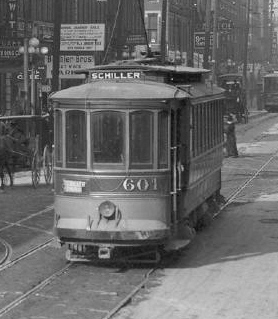
Make them free. Run them on High Street from Worthington to Bexley. Keep them running till 2:00 am on Fridays and Saturday. Keep them free, even if they're losing money. Don't go modern. Free cars are the best. Don't go mod. Pay homage to our history with a classic design. Did I say free? Free. Free. Free.

So until Mayor Coleman comes through with his proposal (and figures out how to fun my FREE project), I have no choice but to gut it out with COTA. There are, sadly, no other options. With winter closing in, you won't catch me on my Giant. It'll still take 87 minutes to get home. I'll still stand at my cold, shelter-less bus stop. I'll still wonder why cyclists are lapping us. And I'll bring brats and saurkraut. Why? The 425 pound man loves to eat brats on cramped buses.

Oddly enough, the smell is usually a welcome change. I think of it as his cologne.

Here's some additional factoids that force my continued support. Peruse them at will.

From the American Public Transportation Association website:

Fact Sheet
September 26, 2007
(Download In Adobe PDF format)

Background on Transportation and CO2 Emissions

-U.S. greenhouse gases (GHGs) from transportation represent 33% of total U.S. GHG emissions

-GHG emissions from mobile sources have grown 29% from 1990 to 2004, an average annual compound growth rate of almost 2.0 percent.

-Automobiles and light trucks are the largest sources of greenhouse gas emissions from mobile sources and together represent more than about 60% of total mobile source greenhouse gas emissions.

-CO2 represents over 95% of total greenhouse gas emissions from mobile transportation.

Transportation Industry’s Contribution to CO2 Emissions Reduction

-Nationally, public transportation reduces CO2 emissions by 6.9 million metric tones annually.

-Public transportation’s reduction of 6.9 million metric tonnes exceeds the transportation CO2 emis­sions that exist in states such as North Dakota (6.3 mil­lion metric tonnes) and Delaware (5.0 million metric tonnes).

Household Actions – the Potential Power of Individual Action

-The average American household carbon footprint is 22 metric tonnes per year, compared to a European household of 10 metric tonnes per year. Of this, approximately 38% (One car household) to 55% (two car household) of total household CO2 emissions are transportation related.

-A solo commuter switching his or her commute to existing public transportation a single day can reduce their CO2 emissions by 20 pounds or more than 4,800 pounds in a year, about ten percent of a two-car family household’s carbon footprint of 22 metric tonnes per year.

-Switching your commute to public transportation reduces a family’s carbon footprint more than replacing five incandescent bulbs to lower wattage compact fluorescent lamps (445 pounds of CO2 per year), or replacing an older refrigerator freezer (335 pounds of CO2 per year.

-Eliminating one vehicle and using public transit can reduce a two-car household’s carbon footprint between 25-30%. A two-car household switching all travel to transit can reduce their carbon footprint by up to 55%.

*prior to this year, I had never set foot in a public bus. Growing up in the Ohio burbs, there was never any reason to do so. We are and always have been a car city.

Tuesday, October 16, 2007

If only they were cleaner on the inside...

While the New York Time's City Room Blog has some less-than-kind things to say about the aesthetics of New York's new hybrid turbine buses, I think they're Airstreamariffic.


From William Neuman's article:

The city’s other hybrid buses run like hybrid cars. They run off battery power some of the time and diesel or (in the case of many cars) gas engines at other times. And the braking action helps charge the batteries.

The test bus is different in that it runs on battery power all the time. It has a diesel engine, but that is used only to charge the battery, although the bus also uses the brakes for that purpose. The diesel engine is different too. It is a turbine engine.


Read more here...

Monday, August 27, 2007

10-4 on the carbon footprint, good buddy...

Ahh Seattle, why must you always be so hip?

I read an article a while back about the possible implementation of hybrid technology into big-rig, 18 wheel behemoths. What I assumed was another case of greenwashing, is in fact a reality.

Dunn Lumber of Seattle, Washington is officially the first company to test out Kenworth's new Paccar PX-6 240 hp engine. The class 7 hybrid can carry and 8 ton payload (!) and features a transmission mounted generator, with a 340-volt frame-mounted battery.

From the article:

Above 30 mph, the Kenworth hybrid operates like a standard diesel vehicle with all power coming from the engine during steady driving conditions. Below 30 mph, it uses a combination of diesel and electricity with the system automatically switching between the two modes of operation. Electricity generated through regenerative braking is stored and used for acceleration, assisting the diesel engine.


Alas, Kenworth is only giving up these green beauties in limited quantities to local municipal companies and fleets...until 2008, that is.

And if Smokey, Bandit, and the rest of the guys are going green, maybe it's time for me to start that organic chewing tobacco company I've always dreamed about.

Speaking of "tomacco," Otto will get a buzz out of knowing that California's also making their mark with this new treat: the first plug-in hybrid bus.
Bus manufacturer extraordinaire I-C Corp. is charging around $200k per bus, with most school districts off-setting the majority of the cost with grants.

From their flash-saturated website (with some damn cool pictures):

Depending on the route, fuel mpg improvement is from 20% to 50% better for Charge Sustaining and up to 70% better for Charge Depleting systems. Emission improvements vary with the pollutant being measured and has shown up to a 90% improvement at times on Particulate Matter, again, this is load and operating condition dependent.

But wouldn't ya know it...just as we start solving some problem areas, new ones fill the pores.

My search for hybrid construction equipment resulted in a surprising combination of words: Hybrid Backhoes.


But don't let the name fool you. The only thing that makes them a "hybrid" is the fact that they can perform construction detail AND do a street-legal 65 mph on the freeway.

So now that we've developed the technology to transport heavy items using clean(er) hybrid technology, said items now transport themselves...at a high rate of speed.

From the story:

In June, the HMEE (High Mobility Engineer Excavator) was officially introduced in a formal unveiling ceremony. The highly specialized equipment features a 6.7-liter diesel engine, antilock brakes, four-wheel drive, six forward speeds and two reverse speeds.

It can lift more than two tons and dig to a depth of 13 feet...


Granted, the backhoes are solely intended for military use (with armor plating...about time!), I don't doubt that the possibility that I might on day find a 2 meter dump scoop in my rear-view mirror.

I will happily merge from my lane and let that machine pass.


Thursday, July 19, 2007

Building takes peaces....

Architects for Peace asks that all professionals of the built environment provide 1% of their time to pro bono work.


Their pro bono services provide options to those who could not otherwise afford them. At the same time, such work encourages public discourse in relation to building and environment, forcing Architects and Planners to immediately ask: What impact will this building have on these people, their health and their city (as should be the process EVERY TIME). Truly a great way to promote education, participation and environmental reclamation.

How It Works:

Architects for Peace pro bono service acts as a bridge between community groups, non-profit agencies and charitable organisations that need architectural services but cannot afford to pay for them (the ‘Clients’) and professionals of the built environment who are prepared to work with these groups free of charge (the ‘Service Providers’). The roles of the Service Providers (arch-peace’s members), the Clients and the Arch-Peace pro bono team are explained in detail below. The main contractual relationship is between Clients and Service Providers, with Arch-Peace providing a linking and facilitating role. The process is illustrated in the following flow chart:


Now, I only wish we could get a forum similar to their "Transported" for the City of Columbus and their City Planners. I've all but given up on biking to/from work for safety reasons (not to mention two of our staff were struck by cars during Bike-to-work month). I still take the bus whenever I can, but the hour and 15 minute commute for a 10.6 mile trip leaves something to be desired.