According to the
American Public Transportation Association:
"78 million more trips taken than last year in the first six months -- New report finds 30% of transit riders are new riders; majority of riders use transit to commute."As a new public transport commuter,* I am pleased by these findings...but dismayed by our Central Ohio public transport.
Just yesterday, I waited for my bus that was scheduled to arrive 5:43. I allotted myself +/- 5 minutes and showed up early. My bus was running late and didn't show up until 6:05. As a result, I missed my connection downtown and waited an additional 20 minutes for the next bus to come. I arrived at home at 7:05.
That's 87 minutes...with only one transfer...to go 12 miles.
Given the fact that the average cyclist
can sustain 13 miles an hour, I recall looking enviously from my rattling window as the two-wheelers passed us by, envious of their ability to run red lights and move their legs freely, unburdened by the 425 pound man
not sitting next to them.

But alas, I must admit, my gripes are few and far between. Let me emphasize that COTA
is not a bad bus system (though it's name is not as cool as Seattle's
South Lake Union Trolley, or S.L.U.T.). The buses are generally clean and the drivers are courteous. Once you figure out the routes, it's not that difficult to get around. And they even provide a healthy vein to bring
OSU fans to and from the packed-to-the-gills games at the Horseshoe.
From
their website:
For the 12 months ending December 2006, COTA provided nearly 15.0 million trips: 14.8 million rides on the fixed-route system and 156,000 paratransit rides. Compared to the prior 12-month period, fixed-route ridership decreased 1 percent and paratransit ridership increased 1 percent.
But if I was working a minimum wage job somewhere in the city, without any flexibility in a work schedule, 45 minutes of "tardiness" can cost me my livelihood. Not to mention 87 minutes is a healthy 12 miles. And the website...don't get me started on the website. Their
Trip Planner is a friggin nightmare, where you need to know the exact case-sensitive punctuation they inputted in order to find out the stop's times. Just a simple pull down menu would work wonders.
And as far as public transportation goes, I recognize that this ebbing and flowing might be par for the course. Their will always be hiccups, but it is important to note that smaller scale bus systems like Columbus need a desperate overhaul. We're 1/20th the size of New York, yet we're based on big city planning without any customization to scale and need. Without street cars, dependable cabs (it's illegal to hail a cab in Columbus!) or a subway system, the lucky carless few are invariably stuck inside the
270 outerbelt.
From
Wikipedia:
COTA has studied the feasibility of constructing a light rail line, a streetcar line, or a bus rapid transit line several times in recent years, but has failed to secure funding for any system beyond the current bus service. COTA's most recent attempt, FastTrax/North Corridor, was permanently tabled in the summer of 2006. Columbus did not meet current federal feasibility regulations, and did not receive federal funding, which was expected to cover over half the cost. No light rail lines are expected to be built in the near future, though the city of Columbus is still considering a streetcar system in downtown Columbus.[4]Just
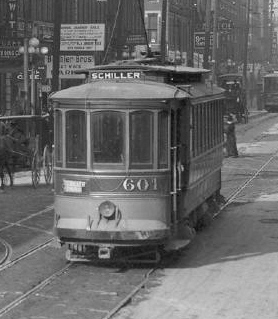
give me my street cars, damn it! That's all I ask.
The debate has been on the table so long that I'm starting to give up hope, but here's what I want:
Make them free. Run them on High Street from Worthington to Bexley. Keep them running till 2:00 am on Fridays and Saturday. Keep them free, even if they're losing money. Don't go
modern. Free cars are the best. Don't go mod. Pay homage to
our history with a
classic design. Did I say free? Free. Free. Free.

So until Mayor Coleman comes through with his proposal (and figures out how to fun my FREE project), I have no choice but to gut it out with COTA. There are, sadly, no other options. With winter closing in, you won't catch me on
my Giant. It'll still take 87 minutes to get home. I'll still stand at my cold, shelter-less bus stop. I'll still wonder why cyclists are lapping us. And I'll bring brats and saurkraut. Why? The 425 pound man loves to eat brats on cramped buses.
Oddly enough, the smell is usually a welcome change. I think of it as his cologne.
Here's some additional factoids that force my continued support. Peruse them at will.
From the
American Public Transportation Association website:
Fact SheetSeptember 26, 2007
(
Download In Adobe PDF format)
Background on Transportation and CO2 Emissions-U.S. greenhouse gases (GHGs) from transportation represent 33% of total U.S. GHG emissions
-GHG emissions from mobile sources have grown 29% from 1990 to 2004, an average annual compound growth rate of almost 2.0 percent.
-Automobiles and light trucks are the largest sources of greenhouse gas emissions from mobile sources and together represent more than about 60% of total mobile source greenhouse gas emissions.
-CO2 represents over 95% of total greenhouse gas emissions from mobile transportation.
Transportation Industry’s Contribution to CO2 Emissions Reduction
-Nationally, public transportation reduces CO2 emissions by 6.9 million metric tones annually.
-Public transportation’s reduction of 6.9 million metric tonnes exceeds the transportation CO2 emissions that exist in states such as North Dakota (6.3 million metric tonnes) and Delaware (5.0 million metric tonnes).
Household Actions – the Potential Power of Individual Action-The average American household carbon footprint is 22 metric tonnes per year, compared to a European household of 10 metric tonnes per year. Of this, approximately 38% (One car household) to 55% (two car household) of total household CO2 emissions are transportation related.
-A solo commuter switching his or her commute to existing public transportation a single day can reduce their CO2 emissions by 20 pounds or more than 4,800 pounds in a year, about ten percent of a two-car family household’s carbon footprint of 22 metric tonnes per year.
-Switching your commute to public transportation reduces a family’s carbon footprint more than replacing five incandescent bulbs to lower wattage compact fluorescent lamps (445 pounds of CO2 per year), or replacing an older refrigerator freezer (335 pounds of CO2 per year.
-Eliminating one vehicle and using public transit can reduce a two-car household’s carbon footprint between 25-30%. A two-car household switching all travel to transit can reduce their carbon footprint by up to 55%.
*prior to this year, I had never set foot in a public bus. Growing up in the Ohio burbs, there was never any reason to do so. We are and always have been a car city.
 [Photo: Bicycle parking at a library in the Netherlands. The foldable plates on the top of the stands can be lowered over the seats if it begins to rain.]