Tired of the looking for a vegetarian meal in a marinated meat market?
Exhausted in your search for a patchouli-scented siren?
Need some spark in your hookah?
Dreaming of a dreadlocked darling to hacky your sackey?
Want to put the us in your Prius?
I could go on and on...seriously, I could.
But I digress...
While I'm long-since out of the dating pool (thank Ganesh!) with a lovely wife and a healthy-boweled17 month-old son, this little website was still able to catch my eye. To each their own, so why not the tree-hugging set, right?
Ethical Singles: The Matchmaking Service for People who Care about Humans, Animals and the Environment.
OUR MEMBERS INCLUDE: -Green business practitioners! -Vegan vixens! -Organic farmers! -Eco-warriors! -Human rights supporters! -Pacifists! -Wildlife protectors! -Earth-friendly consumers!
I wonder if you can be both pacifist and Eco-warrior, trudging into battle with a bulletless, flower-filled rifle stock? I have a feeling the soldier might look a little something like this... It’s free to join, and as an added bonus there aren't any uppity couples gushing over one another in TV spots.
Hippie love is a wonderful thing. That reminds me, can you believe it's almost time for Comfest?
Well, this past week, I witnessed a State Farm ad in which an African American male stands in suit and spandex, embarrassed about how he needed to switch from four wheels to two because of recent surges in gas prices. He stood on a giant velvet red dot as the announcer proclaimed how "State Farm could get you back behind the wheel by saving you hundreds of dollars on car insurance." Saddened by his bicycle dilemma, the male unlocks his bike to head home as a coworker happens by, sarcastically noting, "Nice pants, Jim." Not only can he not afford to drive, but the ladies don't like his red bicycle shorts.
Needless to say, I wasn't very appreciative of the ad. Was the cyclist really put in the same situation as the yellow-plated DUI offenders of the world, mortified by the hollow gaze of his peers in the company parking lot? If anything, I hope we can say that his embarrassment was a result of his outfit. The spandex/suit jacket doesn't really work all too well, so why go aerodynamic solely from the waist-down?
Anywhoo, Streetsblog approached it wonderfully and the comment gates opened up, offering them a little more than they anticipated in terms of action. Here are some of my favorites from their contributing masses:
#12. Dan o: "...if they're trying to get crossover life insurance business, where's the guy's helmet?"
#17. Steve Ardrey: "...I routinely commute to work by public transit and BICYCLE. This keeps my mileage for insurance below 5k a year thus lowering my insurance rates."
#20. Ubrayj02: "This ad presents the option of riding a bike to work (instead of driving) as an emasculating, humiliating, experience - which will leave you struggling with a bike lock outside of work while your car-driving coworkers breeze by.
The skinny pants are meant to show how vulnerable men's genitals will be if they dare to use their bike to get around..."
Turns out, what I thought was just another good post --Freudian genital analyzation included-- was actually quite engaging. Apparently the blogbees buzzed loud enough that Streetsblog author Aaron Naparstekreceived a response (in the comment section, no less) from State Farm's Director of Marketing Communications, Tim Van Hoof. A proactive response to a legitimate customer concern...in a technologically advanced medium such as a blog? Huh?!?! You can read that HERE. Be sure to check out the comments, also.
So basically...(Great post + Great comments) x Great response = My new favorite blog.
Quite some time ago there was an article in Good Magazine titled, Decongestion: Five innovations in urban transportation that you won't find in America, yet. I was really impressed with Copenhagen and the length the Danes went to to create a bicycle-friendly city, so much so that we sent the link out to anyone and everyone that had local influence over urban planning and design. That was then. Now that the Mid Ohio Regional Planning Commission is looking for comments and suggestions as to the future of downtown Columbus, I thought nothing of forwarding the terrific StreetFilm links. Surprisingly, I received a direct response with 30 minutes from one of the Principal Planners, and hope that they truly take some of these wonderful ideas to heart.
Now, considering I was almostclipped twice last week on my ride home from work, the issue hit pretty close to home. While both of the aforementioned near-crash instances were a result of text-while-driving idiots, Ohio continues to ignore the implementation of hands-free laws nationwide. If this continues, it's safe to say (literally) that I want as much space as possible between us and them. Cement/trees/cars/pylons/unicorn statues...whatever.
What's more, is the fact that you can make some tremendously interesting barriers. While the parked cars typically act as the traditional buffer between cyclist and traffic, it's also possible to liven them up, adding trees and shrubs to the space and giving the metro area some greenscape in a place typically void of such surroundings. The more green downtown, the better.
See the StreetFilm argument for yourself:
And their movies are really catching on. Over the last year, StreetFilms has received over 500,000 views. While that might not be monkey-drinking-its-own-pee kind of numbers, it's huge when you consider genre-specific nature.
I am both sad and ecstatic at the prospect of spring...
The snow is officially gone and we have crawled out of our winter dens. I've been biking (weather permitting) to and from work as often as I can, and it feels great to be in motion again. I've packed on some winter pounds and with gas prices as high as ever, I can't think of a reason not to commute on two wheels.
But alas, as I put petal to the pavement I can't help but notice a grime. A filth. A yuck.
In addition to avoiding the 9,487,341,245 potholes from our city's use of cheap, non-Snowbelt grade pavement, I've found myself bouncing over bottles, swerving past cigarette packs, riding around wrappers, a flailing over fast food bags.
The snow plows, while adept at pushing snow off of our roads, also transport and and all rubbish to the curbside. Seeing as we've (yet) to install any bike lanes on any of our streets, this has left for some utterly disgusting rides.
Wanna see what I'm talking about?
You get this:
From this:
Welcome to beautiful Columbus.
Anywhoo...
In honor of Earth Day weekend --!April 25th-27th!-- my firm is sponsoring a clean-up at a Frisbee golf course near Grigg's Reservoir (it doesn't get anymore hippie than that), as well as an all-office/landscape scrubbing around the perimeter of our building (we happen to be situated at the north end of a quarry and the wind blows all the trash our direction, so we're constantly flooded with garbage).
I'm thinking I might need to extend that clean-up to my ride home. I encourage anyone and everyone who reads this little hole-in-the-wall to do the same.
Grab a biodegradable bag and a pair of gloves and hit your street/school/church/work/park/library/bar. Help get some of this disgusting grime off our roads.
The forsythia is about to bloom, so why not make a better backdrop for her pictures.
Columbus Forsythia picture from Flickr user jfsl3.
"78 million more trips taken than last year in the first six months -- New report finds 30% of transit riders are new riders; majority of riders use transit to commute."As a new public transport commuter,* I am pleased by these findings...but dismayed by our Central Ohio public transport.
Just yesterday, I waited for my bus that was scheduled to arrive 5:43. I allotted myself +/- 5 minutes and showed up early. My bus was running late and didn't show up until 6:05. As a result, I missed my connection downtown and waited an additional 20 minutes for the next bus to come. I arrived at home at 7:05.
That's 87 minutes...with only one transfer...to go 12 miles.
Given the fact that the average cyclist can sustain 13 miles an hour, I recall looking enviously from my rattling window as the two-wheelers passed us by, envious of their ability to run red lights and move their legs freely, unburdened by the 425 pound man not sitting next to them.
But alas, I must admit, my gripes are few and far between. Let me emphasize that COTA is not a bad bus system (though it's name is not as cool as Seattle's South Lake Union Trolley, or S.L.U.T.). The buses are generally clean and the drivers are courteous. Once you figure out the routes, it's not that difficult to get around. And they even provide a healthy vein to bring OSU fans to and from the packed-to-the-gills games at the Horseshoe.
For the 12 months ending December 2006, COTA provided nearly 15.0 million trips: 14.8 million rides on the fixed-route system and 156,000 paratransit rides. Compared to the prior 12-month period, fixed-route ridership decreased 1 percent and paratransit ridership increased 1 percent.
But if I was working a minimum wage job somewhere in the city, without any flexibility in a work schedule, 45 minutes of "tardiness" can cost me my livelihood. Not to mention 87 minutes is a healthy 12 miles. And the website...don't get me started on the website. Their Trip Planner is a friggin nightmare, where you need to know the exact case-sensitive punctuation they inputted in order to find out the stop's times. Just a simple pull down menu would work wonders.
And as far as public transportation goes, I recognize that this ebbing and flowing might be par for the course. Their will always be hiccups, but it is important to note that smaller scale bus systems like Columbus need a desperate overhaul. We're 1/20th the size of New York, yet we're based on big city planning without any customization to scale and need. Without street cars, dependable cabs (it's illegal to hail a cab in Columbus!) or a subway system, the lucky carless few are invariably stuck inside the 270 outerbelt.
COTA has studied the feasibility of constructing a light rail line, a streetcar line, or a bus rapid transit line several times in recent years, but has failed to secure funding for any system beyond the current bus service. COTA's most recent attempt, FastTrax/North Corridor, was permanently tabled in the summer of 2006. Columbus did not meet current federal feasibility regulations, and did not receive federal funding, which was expected to cover over half the cost. No light rail lines are expected to be built in the near future, though the city of Columbus is still considering a streetcar system in downtown Columbus.[4]
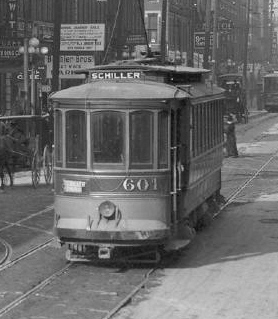
Just give me my street cars, damn it! That's all I ask. The debate has been on the table so long that I'm starting to give up hope, but here's what I want:
Make them free. Run them on High Street from Worthington to Bexley. Keep them running till 2:00 am on Fridays and Saturday. Keep them free, even if they're losing money. Don't go modern. Free cars are the best. Don't go mod. Pay homage to our history with a classic design. Did I say free? Free. Free. Free.
So until Mayor Coleman comes through with his proposal (and figures out how to fun my FREE project), I have no choice but to gut it out with COTA. There are, sadly, no other options. With winter closing in, you won't catch me on my Giant. It'll still take 87 minutes to get home. I'll still stand at my cold, shelter-less bus stop. I'll still wonder why cyclists are lapping us. And I'll bring brats and saurkraut. Why? The 425 pound man loves to eat brats on cramped buses.
Oddly enough, the smell is usually a welcome change. I think of it as his cologne.
Here's some additional factoids that force my continued support. Peruse them at will.
-U.S. greenhouse gases (GHGs) from transportation represent 33% of total U.S. GHG emissions
-GHG emissions from mobile sources have grown 29% from 1990 to 2004, an average annual compound growth rate of almost 2.0 percent.
-Automobiles and light trucks are the largest sources of greenhouse gas emissions from mobile sources and together represent more than about 60% of total mobile source greenhouse gas emissions.
-CO2 represents over 95% of total greenhouse gas emissions from mobile transportation.
Transportation Industry’s Contribution to CO2 Emissions Reduction
-Nationally, public transportation reduces CO2 emissions by 6.9 million metric tones annually.
-Public transportation’s reduction of 6.9 million metric tonnes exceeds the transportation CO2 emissions that exist in states such as North Dakota (6.3 million metric tonnes) and Delaware (5.0 million metric tonnes).
Household Actions – the Potential Power of Individual Action
-The average American household carbon footprint is 22 metric tonnes per year, compared to a European household of 10 metric tonnes per year. Of this, approximately 38% (One car household) to 55% (two car household) of total household CO2 emissions are transportation related.
-A solo commuter switching his or her commute to existing public transportation a single day can reduce their CO2 emissions by 20 pounds or more than 4,800 pounds in a year, about ten percent of a two-car family household’s carbon footprint of 22 metric tonnes per year.
-Switching your commute to public transportation reduces a family’s carbon footprint more than replacing five incandescent bulbs to lower wattage compact fluorescent lamps (445 pounds of CO2 per year), or replacing an older refrigerator freezer (335 pounds of CO2 per year.
-Eliminating one vehicle and using public transit can reduce a two-car household’s carbon footprint between 25-30%. A two-car household switching all travel to transit can reduce their carbon footprint by up to 55%.
*prior to this year, I had never set foot in a public bus. Growing up in the Ohio burbs, there was never any reason to do so. We are and always have been a car city.
Thisplaceis has an interesting post on sacred spaces. I found it interesting because my firm is currently prepping for our annual Principals' Meeting, a portion of which will be held at the recently opened Bar of Modern Art in Columbus, and I've always wondered about that rehab.
Developer Gary Gitlitz turned BoMA from an historic Baptist church into a bar/nightclub/100-seat dining room. Funny thing is....this is the Midwest....so I was fairly surprised when only I seemed to have reservations about the church-turned-into-house-o-sin metamorphosis.
Shin-pei Tsay, one of three contributors at Thisplaceis, brought up a location in New York that curbed my misgivings about sacred spaces in general (he also talked about absinthe, which gave me an instant flashback hangover). It's the New York City Marble Cemetery, a liger-like combination of somber reflection and socializing. Monday through Thursday it's your typical cemetery, but Friday through Sunday it's encouraged to be used as a park.
In the interest of full disclosure I must admit that I believe that burial, in itself, is a selfish act. To me, it signifies a desperate grab at immortality by peeing on a tree and claiming it yours for all of eternity...or in this case a 6' x 4' plot of land. As a result, I'm now torn on these Eco-Cemeteries that appear to be popping up (or down) all over the place.
Anyway, so while I'm not planning on holding a burial after my party is busted God's police, I do, however, retain a large amount of respect for the land the ground-sleepers have chosen as their final resting place (lack of couth with terms like ground-sleepers notwithstanding).
To each their own...may their God/next life treat them well.
So prior to this I had never considered the notion that a place like a cemetery could be predispositioned as a shared-use space. Although the New York Marble Cemetery had (apparently) evolved into its shared-usedness (my word), why not make them into places of gathering/celebration/familia.
Likewise, is there really a problem with a church-turned-nightclub conversion if the conversion, when finished, is done tastefully, without disrespect to the prior history of that space? Although some might argue that a bar-conversion for a Baptist church like BoMA might not be the best renovation possible, the end result is, in all honesty, quite nice. And isn't a church intended for celebration?
Thoughts? Sacrilege or preservation?
Check out thisspaceis for pictures of the New York Marble Cemetery.
The head of the Sustainable Design Group in Columbus recently sent us this link to Walk Score, a web site intended to help people find walkable places to live (sponsored by the Sightline Institute). It's also been featured on the illustrious Book of Joe.
While their target audience might be home buyers, this website is actually incredibly interesting to reference for work, university, and/or favorite businesses (OK...not incredibly interesting...more like a cool interwidget that allows you to brag to your suburbanite cohorts).
One-Mile Walk in a Compact Neighborhood
A one-mile walk in Seattle's Phinney Ridge, takes you through a grid like street network with a mix of residences and businesses (shown in purple). Map courtesy of the Sightline Institute.
While I was quite proud our home in Columbus as it scored a 79 out of a possible 100, our LA, San Francisco and New York offices scored 91, 97 and 100's, respectively. Joe, however, scored a 9...but who needs to tell that guy about walking? He only walks about 5600 miles a day while blogging from his treadmill. Seriously.
One-Mile Walk in a Sprawling Suburb
A one-mile walk in Bellevue, WA with cul-de-sacs and winding streets has few shops and services within walking distance. Map courtesy of the Sightline Institute.
Ahh....to live in the metros of metro. Actually, put me within walking distance of Taco Mesa in Southern Orange County and I'm set on food and drink for life. A couple of fish tacos and a Negro Modelo, what more do you need?
90 - 100 = Walkers' Paradise: Most errands can be accomplished on foot and many people get by without owning a car. 70 - 90 = Very Walkable: It's possible to get by without owning a car. 50 - 70 = Some Walkable Locations: Some stores and amenities are within walking distance, but many everyday trips still require a bike, public transportation, or car. 25 - 50 = Not Walkable: Only a few destinations are within easy walking range. For most errands, driving or public transportation is a must. 0 - 25 = Driving Only: Virtually no neighborhood destinations within walking range. You can walk from your house to your car!
As I continue to pop pills and down liquids, here's an interesting article I found in the Washington Post, profiling the down-sizing of Virginian suburbanites.
As a Central Ohioan, I've never quite understood the "suburban dream." Downtown Columbus is currently surrounded with endless sprawl, rows and rows of long-commute suburbs that clog our highway arteries each morning and afternoon. It seems to me that living out there would be more trouble than it is perceived.
...but (you knew it was coming) the truth of the matter is this: families will come if and when the general stigma surrounding Columbus Public Schools is eliminated, even though that fear is unfounded, given schools like Columbus Alternative High School see 98% of their graduating seniors advance onward to college.
Architects for Peace asks that all professionals of the built environment provide 1% of their time to pro bono work.
Their pro bono services provide options to those who could not otherwise afford them. At the same time, such work encourages public discourse in relation to building and environment, forcing Architects and Planners to immediately ask: What impact will this building have on these people, their health and their city (as should be the process EVERY TIME). Truly a great way to promote education, participation and environmental reclamation.
How It Works:
Architects for Peace pro bono service acts as a bridge between community groups, non-profit agencies and charitable organisations that need architectural services but cannot afford to pay for them (the ‘Clients’) and professionals of the built environment who are prepared to work with these groups free of charge (the ‘Service Providers’). The roles of the Service Providers (arch-peace’s members), the Clients and the Arch-Peace pro bono team are explained in detail below. The main contractual relationship is between Clients and Service Providers, with Arch-Peace providing a linking and facilitating role. The process is illustrated in the following flow chart:
Now, I only wish we could get a forum similar to their "Transported" for the City of Columbus and their City Planners. I've all but given up on biking to/from work for safety reasons (not to mention two of our staff were struck by cars during Bike-to-work month). I still take the bus whenever I can, but the hour and 15 minute commute for a 10.6 mile trip leaves something to be desired.
This site is not affiliated with my work and/or its clients and/or its vendors. The views expressed in this blog are solely the opinions of me, myself and I.
1) Everything is meant in good fun. 2) At this time, there is just too much cool stuff on the interwebs and this is my way of keeping track of it all. 3) My intent is to better familiarize myself with an industry I am only beginning to understand.
Well, where to begin? I graduated from Eckerd College in 2000 [St. Petersburg, FL] with a BA in International Law with a Concentration in Human Rights and Genocide Studies. After college I joined the Peace Corps, serving in the Republic of Kiribati in the South Pacific [2001-2003]. I am currently a Buyer for a design in OH.********As the world continues to accelerate and evolve, I am growing more and more fascinated with technology and design. Since I am not formally trained in either of those fields, this blog aims to showcase products/ideas/tech/people I like. Take it for what you will.********Lili Cheng once wrote, "A beautiful side effect of making things is you start to look around and wonder, 'how did they do that?'; you learn to see, analyze, and appreciate different approaches, well-made things, and clever solutions." Surrounded by creativity and cleverness, I can't help but find myself intrigued.
I have a wonderful wife and a healthy-boweled 1 year-old son.


 It’s free to join, and as an added bonus there aren't any uppity couples gushing over one another in TV spots.


 But alas, I must admit, my gripes are few and far between. Let me emphasize that COTA is not a bad bus system (though it's name is not as cool as Seattle's
  So until Mayor Coleman comes through with his proposal (and figures out how to fun my FREE project), I have no choice but to gut it out with COTA. There are, sadly, no other options. With winter closing in, you won't catch me on


 Architects for Peace