Project 10 to the 100th is a call from Google for ideas to change the world by helping as many people as possible. On February 27, Google will choose the best 200 ideas, donating $10 million to help with their implementation. Deadline for submissions is October 20th.
Categories:
Community: How can we help connect people, build communities and protect unique cultures?
Opportunity: How can we help people better provide for themselves and their families?
Energy: How can we help move the world toward safe, clean, inexpensive energy?
Environment: How can we help promote a cleaner and more sustainable global ecosystem?
Health: How can we help individuals lead longer, healthier lives?
Education: How can we help more people get more access to better education?
Shelter: How can we help ensure that everyone has a safe place to live?
Everything else: Sometimes the best ideas don't fit into any category at all.
Criteria:
Reach: How many people would this idea affect?
Depth: How deeply are people impacted? How urgent is the need?
Attainability: Can this idea be implemented within a year or two?
Efficiency: How simple and cost-effective is your idea?
Longevity: How long will the idea's impact last?
Monday, October 13, 2008
Google gives your ideas an allowance...


Wednesday, July 2, 2008
Freedom Towers aren't free...
 Due to ongoing budget woes, it looks as though the Santiago Calatrava-designed structure will need to undergo a post-design facelift. Some might find this sad, but judging by the comments section in the story below, NY locals think the money should obviously be spent elsewhere.
 From Gothamist:
Now that everyone knows rebuilding efforts at the World Trade Center are over-budget and very delayed, Port Authority executive director Christopher Ward announced that the Santiago Calatrava-designed transit hub would undergo some changes. Namely, the hub's "wings" will no longer close and open.
 CityRoom notes Calatrava had previously said of the hub, "On a beautiful summer day, the building can work not as a greenhouse but as an open space,” on beautiful days and the anniversary of September 11 each year. Now, the Port Authority says, “This is a tough choice, but it is the right choice. It’s reflective of the kinds of choices we simply must make in the coming weeks and months if we are to establish priorities and milestones, to which we can be held accountable.”
Read the rest of the article HERE.
Tuesday, May 13, 2008
Holy Holmenkollen!!!
 The grandiose project was won late last year in a open competition by Danish Architect, Julien De Smedt, and is now commissioned to be built for the 2011 World Ski Championships! What do you think? The new design is simply awe-inspiring.
 The International Ski Federation had requested that an iconic structure be built for the competition and as you can see, De Smedt didn't disappoint. Given the rich history of skiing in Oslo --in addition to the 600,000+ tourists that visit the existing jump year after year-- it's easy to see that interest in the location and culture will only grow. The ISF should be quite happy with the future of Nordic sport in Norway.
 The jump will be a cantilevered steel structure, eagerly capable of handling the massive weight and power of snow and wind. Near the grounding point of the cantilever, there will a union and restaurant for spectators, tourists and officials. Additionally, there will be a public viewing platform at the crest of the jump, allowing spectators to view the athletes as they launch from into the air. I can only imagine what that view will look like! And with the entire structure lit from within, surrounded in a glass-plate façade, I can imagine the the view from outside the jump will be just as, if not more, breathtaking. To top it off, the peak is cut horizontally to accommodate an additional viewing platform with a 360º panorama view over the Oslo city landscape.
Construction is expected to be completed in 2009.
JDS/Julien De Smedt Architects is a multidisciplinary office, located in Copenhagen, Brussels and Oslo, that focuses on architecture and design, from large scale urban planning to furniture and design.
Monday, February 4, 2008
Theirs is definitely bigger than ours...
The Deutschland-based, multi-national energy company has been on the scene for quite some time, specializing in the production of wind turbines, the construction of desalination plants, and the publication of unfortunately-named magazines (Windblatt). Well, they appear to be VERY ambitious at the first of the three, considering they've now built the turbine to end all turbines...well...that is, of course, until a bigger one comes along.
The E-126 prototype (pictured below) is a behemoth!
 The tower alone is an amazing 131 meters (429 ft) high and required a 180 meter (590 ft) crane for construction.
 The Tower walls are over 45 cm thick and required over 110 cubic meters of concrete to build. Located near the Ems River, the silty ground was soft and required 64 fifty-six-centimeter thick piles driven in to the ground 24 meters deep to support the structure.
 It can power over 5000+ European 4-person homes, but what I like most is the optimized blades that turn in on themselves. In the event of high winds the blades do not shut down completely, but rather tilt like the prop on a place. The drag is reduced and the blades continue to spin at an optimized 12 revolutions per minute.
Read the Press Release pdf (courtesy of Windblatt Magazine) here.
 Original find via Metaefficient.
Wednesday, December 12, 2007
The party is almost over...
Tuesday, September 11, 2007
#2 of a kind....
What?
You heard me right...yes, the bathrooms.
Why low-flush/dual flush toilets have never caught on stateside, I'll never know. Travel anywhere east of Lisbon or west of Papeete and you're bound to find a two-flusher underneath your bum (in addition to, ahem, less scrupulous versions of what some might consider to be a toilet). For those of you that have never experienced them before, the two flusher provides two different levels of flushing power: Level #1 using half the water at code yellow, and level #2 opening up the locks on the dam. Pretty logical, eh?
But for some reason or another, Americans require a 30 gallon SHWOOSHing sound to insure that our poo is whisked away on a 50 mph hour log ride to the water washing plant far, far away from the sterile bubble of home. Think Homer Simpson shouting "USA, USA" in the episode Bart vs. Australia.
Actually, if you're an American you might even consider this conversation a bit too gauche for your virgin ears? My apologies, but as you'll see from a quick googling toilets and restrooms are the talk of the world (I want this one). You haven't lived till you've tried your first Asian squatter.
Back to the conversation at hand...
The crude, frail design of dual-flush toilets has advanced quite a bit over the last decade, so maybe there's a chance we'll see them soon. Up until recently, they've never been able to meet the needs of American sturdiness. Solid construction and sleeker designs will hopefully provide some form of a competitive edge in the US market. Until that time, I guess I'll just keep posting about other crazy designs (some of which might just work!) in loo [sic] of a dual flush post.
One crazy design that caught my attention was the Royal Flush Water Saver.

Whether you're looking to save the environment or your just a fan of the TV show Oz
 , you'll no doubt appreciate this grey water recycling system. We've posted about grey systems before, but the system takes it to a whole new (see: prison-like) level.
 While I think the design is oddly genuine, I still have my reservations about American idiosyncrasies and the toilet/cleanliness combo (see: aforementioned 500 mph log ride). It's obvious between this system and the Aqus system that there is a viable way to recirculate used water back into reservoir tank, but I think the Aqus system might be in the lead, design-wise. I'm just not sure many Americans, obvious as it may be that the hand-washing water isn't coming FROM the toilet, might still think/feel that that the toilet H2O is the source.
Additionally, there are many misconceptions as to the flight patterns of airborne particulate swirling through the bathroom post-flush (FYI: according to Jaime and Adam, that myth was busted). As a result, many might assume that the sink would be infested with germs and bacteria after the first flush, much less the many flushes thereafter.

Still, I can't help but find myself a teensy bit excited at the thought of competitive development in this field (yes, I need to get out more often). It's simple: competitive market interest produces perfected design.
Tuesday, September 4, 2007
1 million dollars if you let me sleep with your country...
 Remember that post a while back about 9-volts not saving the world?
Remember the inventiveness of the children of Guinea?
Well, the World Bank Group is trying to shake things up in the $38 billion (B!) fuel-based global lighting market with a new design competition.
Fancy yourself the Bono of bulbs? Then why not register and compete in Lighting Africa!
From their website:
Lighting Africa is a World Bank Group initiative aimed at providing up to 250 million people in Sub-Saharan Africa with access to non-fossil fuel based, low cost, safe, and reliable lighting products with associated basic energy services by the year 2030.
Currently, 1.7 billion people worldwide are without electricity. The problem is most acute in Sub-Saharan Africa where over 500 million people presently lack modern energy, with rural electricity access rates as low as 2%.
Among the poorest of the poor, lighting is often the most expensive item among their energy uses, typically accounting for 10-15% of total household income. Yet, while consuming a large share of scarce income, fuel based lighting provides little in return.
New advancements in lighting technology, such as compact fluorescent light bulbs (CFLs) and light emitting diodes (LEDs), promise clean, portable, durable, lower cost, and higher quality lighting. The challenge is to make these products accessible to the half billion "energy poor" in Africa. With expenditures on fuel based lighting estimated at US$38 billion annually, the potential exists to engage the international lighting industry in this new market area, while serving consumers, bolstering local commerce, creating jobs, enhancing incomes, cleaning the air, and improving health, safety, and quality of life.
Plus, their little satellite image of Africa at night is pretty cool. I think I can see my house.

So back to the previous posts....
A recipe for winning the Lighting Africa competition (I love the recipe schtick...creative gold...if you ever hear one at a wedding reception, duck and cover).
1) Take the best invention ever created
2) Fold in half a cup of Pedal-A-Watt
3) Add a dash of ingenuity with William Kamkwamba and others
4) Toss in three sprinkles of human powered zero-emissions
5) Encourage technological advancement without pity (I guess that would be considered baking)
-and-
Viola.
Seriously though, does it really take a $200,000 prize to come up with a solution? How much is this problem/will this problem be over-thought until we've blown it up into some abusively researched acrylic monstrosity, decorated to the tilt in Western design stereotypes by people with no understanding of the affecting cultural and socioeconomic norms and traditions of another country?
I'm just frustrated. The designs (typically) have no staying power and never really pan out. If they do, they're implemented with little to no follow-up by an organization that donated the time (see: their name in lights). Parts break, people remain untrained to fix and/or operate the machinery...all goes to waste.
Fortunately, I'm always optimistic that my pessimism is wrong.
Seriously though, check out Afrigadget. There's some amazing stuff there. Check it out already. Go.
Thursday, August 30, 2007
Technodamus Update...
I just ready today that Alan Wiesman has his own website for "The World Without Us" book.
Surprisingly, it can be found at worldwithoutus.com.
Cool little interactive infographic.
I'm off to take a Googling class.
Tuesday, August 28, 2007
Thechnodamus predicts our lack of future...
But the world has evolved into a MacArthur's Maze of tubes, tunnels, generators, plants, dams, and pumps - all of which require a human hand or inputted computer to have dippy birds push their keys and pull their Wonka levers (smile Simpson's fans).
Recently, I read an interesting article from the October 2006 issue of New Scientist (yes, it takes me 10 months to get through a typical NS mag) that asked an important question: As such a dominant species, what would happen to the world - technological infrastructure and all - if every single one of the 6.5 billion people on this planet just disappeared, leaving all our worldly possessions/inventions/chemicals/buildings behind??? How quickly would nature reclaim the planet?
From the article:
If tomorrow dawns without humans, even from orbit the change will be evident almost immediately, as the blaze of artificial light that brightens the night begins to wink out. Indeed, there are few better ways to grasp just how utterly we dominate the surface of the Earth than to look at the distribution of artificial illumination (see Graphic). By some estimates, 85 per cent of the night sky above the European Union is light-polluted; in the US it is 62 per cent and in Japan 98.5 per cent. In some countries, including Germany, Austria, Belgium and the Netherlands, there is no longer any night sky untainted by light pollution.
"Pretty quickly - 24, maybe 48 hours - you'd start to see blackouts because of the lack of fuel added to power stations," says Gordon Masterton, president of the UK's Institution of Civil Engineers in London. Renewable sources such as wind turbines and solar will keep a few automatic lights burning, but lack of maintenance of the distribution grid will scuttle these in weeks or months. The loss of electricity will also quickly silence water pumps, sewage treatment plants and all the other machinery of modern society.
 Think the article is a good read? Buy the hardback version, made of 100% tree.
You might as well, cause it'll take back your planet someday.
Here's a review (via Reed Business Information):
If a virulent virus—or even the Rapture—depopulated Earth overnight, how long before all trace of humankind vanished? That's the provocative, and occasionally puckish, question posed by Weisman (An Echo in My Blood) in this imaginative hybrid of solid science reporting and morbid speculation. Days after our disappearance, pumps keeping Manhattan's subways dry would fail, tunnels would flood, soil under streets would sluice away and the foundations of towering skyscrapers built to last for centuries would start to crumble. At the other end of the chronological spectrum, anything made of bronze might survive in recognizable form for millions of years—along with one billion pounds of degraded but almost indestructible plastics manufactured since the mid-20th century. Meanwhile, land freed from mankind's environmentally poisonous footprint would quickly reconstitute itself, as in Chernobyl, where animal life has returned after 1986's deadly radiation leak, and in the demilitarized zone between North and South Korea, a refuge since 1953 for the almost-extinct goral mountain goat and Amur leopard. From a patch of primeval forest in Poland to monumental underground villages in Turkey, Weisman's enthralling tour of the world of tomorrow explores what little will remain of ancient times while anticipating, often poetically, what a planet without us would be like.
But my favorite is the Washington Post critic:
Who cares?
Sheesh, Post, lighten up.
With the way Conservatives flock to creationism, you think you'd enjoy a little bit of science fiction.
Friday, August 17, 2007
We need to score some design Methadone for Dubai ...
I, like everyone else, was amused at the picture of Tiger Woods hitting a golf ball atop the Burj al Arab.
Then I flinched at the 800m estimation of the Burj Dubai.
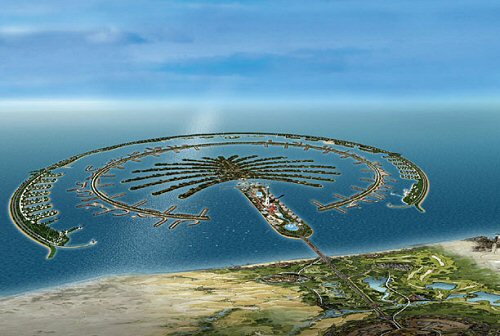
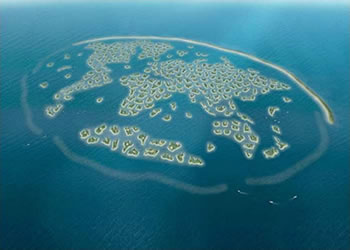
Then came the queasiness of the man-made Palm Island and Dubai World Islands.
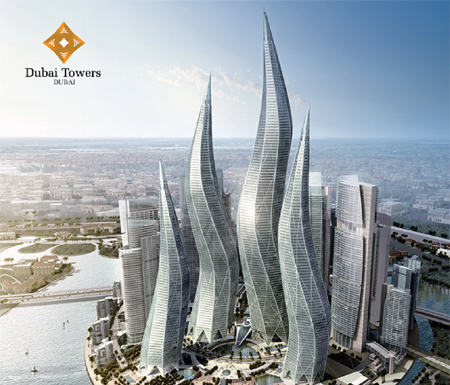
Then Hydropolis, the Burj al Alam, Dubai Towers, and O-14 Tower induced a little bit of architectural nausea.
The list goes on and on and on and on.
Now, a bar made out of ice in 111 degree heat that serves cocktails in a predominantly Muslim country?
Why not?
Story here.

Sheesh.