There are numerous interesting/comical/friendly/provocative/time-squanderable/innovative sites that can completely engulf an evening.
But what I really love is the fact that you can begin a search without direction and, somehow, end up at point B. Initially, you never really had the intention of getting to point B, can't remember what directions you took to get there or how many times you circled the block, didn't even realize you were at point A to begin with, but somehow, someway, ended up at a point B. Basically, I like it because it gives and hour and a half and three glasses of wine some weight, so you don't feel like you completely blew an evening doing squat.
Well, let's take a look what just transpired. Here's the anatomy of my most recent surf...
My search today began as a result of an in-house email link to Green For All, a fairly new organization with (as they put it) a simple but ambitious mission: to help build a green economy strong enough to lift people out of poverty.
I like it. Sustainable job training in the field of sustainability to make employment sustainable? Obviously wonderful.
I couldn't help but think of the South. For those of you following the New Orleans rebuild you will no doubt understand the green movement dilemma that is facing the area. Basically, they're subjecting a bustling area to copious amounts of construction when it (unfortunately) has very few skilled construction workers to handle the construction. So, in my opinion, organizations like this will have a far greater long-term impact than anything else in the philanthropic development field. You should expect to see similar non-profits expand nationwide.
That search-and-surf led me to dig further, so I decided to read other articles about poverty in the south as a result of Katrina. I found this. The statistics told a rough and tumble story in 2005:
Gulf Coast States hit hardest by Katrina: Louisiana, Mississippi, and Alabama
Rates of extreme child poverty in these Gulf Coast states are among the highest in the country.
- In Louisiana, 13% of children live in extreme poverty—the second highest rate of extreme child poverty in the country.
- In Mississippi, 12% of children live in extreme poverty.
- In Alabama, 8% of children live in extreme poverty.
Across the United States, 7% of children live in extreme poverty.
Child poverty rates in these states are also higher than the national average.
- 23% of children in Louisiana live in poor families.
- Nearly a quarter (24%) of children in Mississippi live in poverty.
- 21% of children in Alabama live in poor families.
- Across the United States, 17% of children live in poor families.
So I couldn't help but wonder, where are we now?
I moved on to an excellent resource: the Institute for Research on Poverty. They compile poverty-related articles published throughout the United States and compile them into an (almost) daily post. I've always thought of the IRP is an excellent State of the Union tool in which to gauge the action/inaction of problematic issues far and wide. You get to see which programs are working in which areas and which problems are regrettably recurrent in others.
Here is a small sampling from random dates in their Poverty Dispatch section. I decided to pull these headlines in particular, because I thought it would be interesting to analyze the gulf coast-specific stories in order to separate the positive from the negative. I was hoping to see a transition from mostly bad to hell of a lot better. And sorry about most of the pre-2008 news links. Most of the non-linked articles are outdated and not available, since the smaller online publications don't readily cache their stories like the big boys (and I know, I know...while some of these might not be directly related to Katrina, I still thought they give a small depiction of progress/regression):
2006:
- Public Housing: All Fall Down - Louisiana
- Students with Hurricane-displaced Parents: Students left alone and angry. - Louisiana
- Poverty Under the Stars: The Night the Gulf Coast Civic Works Project was Born
- Alabama Medicaid missing growth trend - Alabama (Outdated Article)
- New Orleans Population Is Reduced Nearly 60%
- Poor are often denied legal aid, panel told -Mississippi
- Renewal money for New Orleans bypasses renters.
- Many of Katrina's migrant workers go unpaid - Louisiana (Outdated Article)
- Miss. poor and working class struggling after Katrina, NAACP says - Mississippi (Outdated Article)
- Katrina's poorest evacuees fare worst, study finds.
- Survey: State fails poor collegians - Alabama (Outdated Article)
- State faces 'rising tide of low-income students,' study says. (Outdated Article)
2007:
- Push on to get children health care - Louisiana
- In Turnabout, Infant Deaths Climb in South
- New law blamed as La. health care rolls cut - - Louisiana (Outdated Article)
- RAND study: Affordable housing lags in Mississippi's post-Katrina recovery. (Outdated Article) - State's poverty dips; still near worst - Alabama
- Study shows dropout numbers worsening - Louisiana (Outdated Article)
- Legislature OKs tax break for low-income residents - Louisiana (Outdated Article)
- New energy for Katrina cleanup. (Outdated Article)
- Little Progress Seen for Poorest After Hurricane
- South leads in early childhood education (Outdated Article)
- Working poor still need relief. (Outdated Article)
- House OKs bill to increase state minimum wage - Mississippi (Outdated Article)
2008:
- Enrollment decline spurs Medicaid changes
- State Children's Health Insurance Program - Louisiana
- So many places to live, but so far out of reach - Louisiana
- Homeless School Age Children - Alabama
- Working poor see little of state's prosperity, group says. - Alabama
While I hoped that this might show a small transition, everything appears to be stagnant. And looking back, I guess I should have known that no publication is going to report on a truly good event unless it's substantially advantageous to the region. The bad will always outweigh the good in reporter world. So this was probably just a big waste of time with, obviously, no statistical merit whatsoever...oh well.
Moving forward.
Since the bad stories had me down, I headed off to find a silver lining...to the place where dreams are made and prayers are answered.
That's right...
...the non-profit, altruistic, fraught-with-financial-strain hippy dippy world. A place I like to call "home."
Numbers and headlines be damned, these organizations have been fighting for the region since first raindrop, so there's bound to be some warmth underneath this wet blanket. They're first responders with follow-up, giving with gusto, energy in action....I could go on and on.
So let's see some of the good they've been doing in order to offset these disheartening figures/stories. What, exactly, is the non-profit community doing to ameliorate the current situation in the south?
Wanna buy a $425 t-shirt?
I know, that headline made me do a double-take, too.
My first philanthropic googling brought me to GOOD Magazine*, a publication I've been praising since the start of '07. I couldn't understand why in the hell they would be promoting a t-shirt for (almost) half-a-grand. That is, until I visited the organization's website Buy A Meter. Not only is the site incredibly creative and well designed...


 ...but the $425 t-shirt comes with a water meter for a Hale County, Alabama family.
Eight young graphic designers from San Francisco, New York, Baltimore, Dallas and Dubai came to Hale County to live among the residents for one month. Inspired by the late architect Samuel Mockbee and the work he did with Auburn University’s Rural Studio, they studied the county's neediest citizens and developed this organization.
One in four families in Hale County are not connected to the municipal water system (wow) and Buyameter hopes to change that. You can buy your shirt and meter HERE.
*Unfortunately, in the same issue of this wonderful magazine you can find a piece about a $250 pizza loaded with lobster and Beluga caviar. How can you promote a $425 meter and a $250 pizza?
Pirates are fighting to save music.
As if Austin wasn't already trendy enough, it now has pirates!
The Pirates for the Preservation of New Orleans Music (PPNOM) is a Texas Nonprofit founded by Texas pirate band The Jolly Garogers. The PPNOM is dedicated to raising funds to rebuild the music education programs of the New Orleans public school system. And if the pirate/Austin connection wasn't hip enough for you, it also works with SXSW and the New Orleans Jazz & Heritage Festival and Foundation.
 It's a small organization, but I thought its inclusion to this post was significant because issues like this are often overlooked. Preference is usually given to projects that physically rebuild the gulf coast and as a result, the creative arts suffer. With cities like New Orleans --cities that literally bleed music-- it'll be undoubtedly hard to carry on the tradition of song and dance if the succeeding generation never touches a trumpet, sings a scale or beats a drum. So while I'm sure there are a ton of other non-profits doing something similar, gimme a break...I'm just doing a search here.
Children are still suffering the effects of trauma from Hurricane Katrina.
OK, that statement might be obvious to most, but think about it...
Think about the graphic images we witnessed as the hurricane made landfall. Graphic images we witnessed from the comfort of our couches. How fresh are those images in your memory? Now imagine that you're a six year-old child being held above water as your father wades laboriously through sludge and debris to an awaiting fishing boat. A stranger takes you in their arms. Your home is destroyed. Your mother is in tears. You are soaked to the bone. How fresh are those images for you now?
Project Fleur-de-lis is an extensive mental recovery effort aiming to soften those troubled memories through communication, rehabilitation, training and support.
They offer a three-tiered program of rehabilitation called a "Stepped Trauma Pathway" that includes therapy and intervention. It identifies and addresses all psychological or psychoeducational problems (sorry Tom Cruise) that occur in children and adolescents. Studies show that 80 – 90% of those touched will be helped in their first tier of care.
 It really is some amazing work. See the results for yourself HERE.
Sitting around the digital campfire, telling their stories.
Elie Wiesel once said, "There are victories of the soul and spirit. Sometimes, even if you lose, you win."
I think we can all agree that the stories of Katrina need to be told. Fortunately, the Hurricane Digital Memory Bank is here to listen. Their aim is to collect and record these stories, compiling a virtual compendium of heartbreak, hope, sadness, and memory.
From their website:
The Hurricane Digital Memory Bank uses electronic media to collect, preserve, and present the stories and digital record of Hurricanes Katrina and Rita. George Mason University’s Center for History and New Media and the University of New Orleans, in partnership with the Smithsonian Institutions National Museum of American History and other partners, organized this project.
Generously funded by the Alfred P. Sloan Foundation, the Hurricane Digital Memory Bank contributes to the ongoing effort by historians and archivists to preserve the record of these storms by collecting first-hand accounts, on-scene images, blog postings, and podcasts. We hope to foster some positive legacies by allowing the people affected by these storms to tell their stories in their own words, which as part of the historical record will remain accessible to a wide audience for generations to come.
You can browse contributor's stories HERE. Some bring tears to your eyes, others are comical. But whatever you read, I think it's important that we really reflect on the life experiences of these people. It's imperative that we understand their story in order properly diagnose, analyze and rebuild their world. Additionally, such a forum for survivors can only aid in the mental rehabilitation of the afflicted and bring on a proper --albeit distorted-- form of closure. It's mere existence is tragically wonderful and entirely necessary.
Because the dirt is dirty.
The Common Ground Collective is a non-profit that formed in the wake of Hurricane Katrina to provide immediate aid to residents in the Gulf Coast region, as well as long-term support in rebuilding their communities in just and sustainable ways. This volunteer organization is huge. It's grown to over 50 organizations with a network of over 1700 volunteers providing relief to more than 50,000 residents in four Parishes - New Orleans, St. Bernard, Plaquemines, and Terrabone.
CGC operates four distribution centers, free medical clinics, emergency home repair, legal and eviction defense work, free computer and phone access, a women and children’s center, and other related projects. Ambitious much?
 Let's look at one of their projects...
The Meg Perry Healthy Soil Project focuses on ways in which the community can restore its land and environment using the safest, most practical methods. They are currently testing various areas --including Gert Town, the Lower 9th Ward, and the zone affected by the Murphy Oil spill in St. Bernard’s Parish-- looking for toxins and heavy metals. If any are detected, then they combine their efforts with communities and homeowners to reduce health risk from contaminated soil through NATURAL bioremediation.
Very cool.
OK, my search is over and it's time for bed...
I think it's safe to say that the entire disaster was mishandled (that's putting it lightly) in the very beginning and our government is very much to blame, but the Gulf Coast would be nothing without altruistic spirit of the concerned American.
A quiet evening of search-and-surf has made me realize that instead of playing the blame game (like I typically do), we need to periodically take a step back and embrace those that are embracing our nation. It's emotionally engaging to dig deep and see how many people are doing excellent work and, in the past, I now realize that I've been focusing my efforts far too often on the sour instead of the sweet. Why not build up those that are rebuilding?
You see? You travel along the interwebs with no intention of going anywhere, yet you somehow end up at a point b.


 The Tower walls are over 45 cm thick and required over 110 cubic meters of concrete to build. Located near the Ems River, the silty ground was soft and required 64 fifty-six-centimeter thick piles driven in to the ground 24 meters deep to support the structure.
 It can power over 5000+ European 4-person homes, but what I like most is the optimized blades that turn in on themselves. In the event of high winds the blades do not shut down completely, but rather tilt like the prop on a place. The drag is reduced and the blades continue to spin at an optimized 12 revolutions per minute.
 Original find via
  What if you could simply reuse packaging as part of a product rather than sending away for disposal or recycling? Some industrial designers have taken up the challenge with varied results. Like
  How could you resist those lines? I definitely wouldn't kick it out of my camp site...classic whitewalls, beautiful curves, simplicity...ahhh, to dream.
 Or this crunched version:
 Or this stretch mod with pristine paint:
 I swear, those fold-out windows make me giddy every time.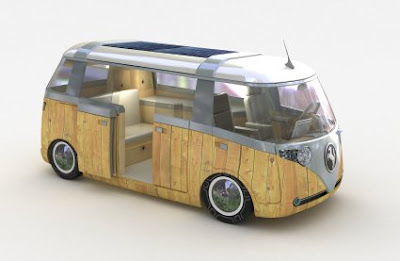
 It has just about everything. And the everything has just about everything. For instance, this solar/diesel hybrid doesn't employ simple solar tech, but instead uses modern solar-tracking technology that follow the sun's path for maximum exposure. The cooking range swivels so you can get your soy dog on both inside AND outside of the van.
 There's also other light touches: a multi-media computer with wireless internet, a maple exterior veneer, a pneumatic suspension for stationary stability (when lowered), an energy consumption dashboard, a passenger seat that turns into a staircase (seriously), and a half door that also turns into stairs:
 For his work, Verdier and his team received the Special Prize at the Caravaning Design Award 2006/2007 at the Caravan Salon in Dusseldorf, Germany. The Salon is one of Europe's largest caravan exhibition and trade shows.


 Quakers
 Jainism
 Oddly enough, it was also used as a sound, with the dot-dot-dot-dash (di-di-di-dah) of Morse code. Coincidentally this sounds a lot like the opening bars of Beethoven's Symphony No.5 (and the Roman numeral for 5 is V!). As a result these bars were (along with the Morse code signal) broadcast by the BBC constantly during the war and became known as 'Fate knocking at the door'. Very cool.
 Want more peace-related goodness? Why not find out


 'Solar One' in Boulder City, Nevada:
 Decommissioned 'Solar Two' in Daggett, California:
 Where are solar towers going to take us? Well, the January 2008 issue of Scientific American believes that we're on the verge of "